
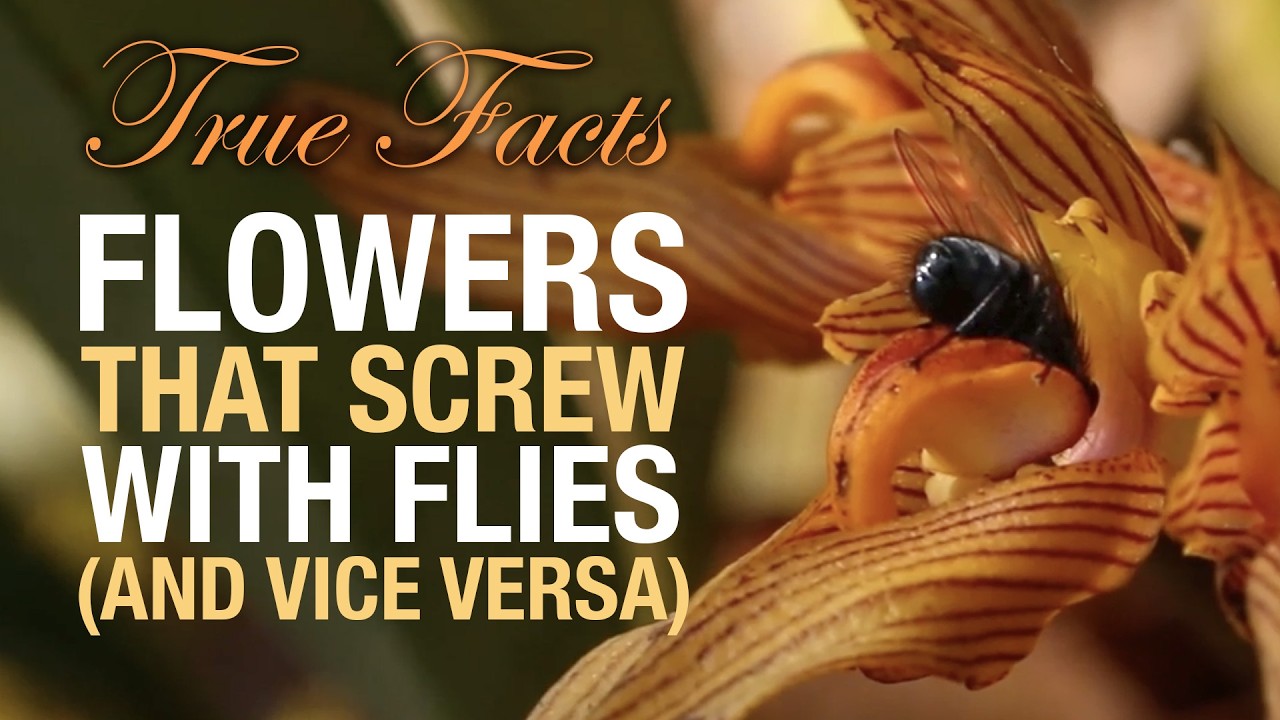
True Facts: Flowers That Screw Flies
Join me at https://www.patreon.com/truefacts
Merch: https://ze-true-store.myshopify.com/
TF Educational channel: @truefactseducational9288
Thank you Dr. Steven Johnson, Bruce Anderson, Dr. Timotheüs Van der Niet.
Citations:
Bjçrn Bohman et al. 2017. The Spider Orchid Caladenia crebra Produces Sulfurous Pheromone Mimics to Attract its Male Wasp Pollinator. Angew. Chem. Int. Ed. 2017, 56, 8455 –845.
https://doi.org/10.1002/anie.201702864
Herbert Braunschmid et al. 2017. Interpopulation variation in pollinators and floral scent of the lady’s-slipper orchid Cypripedium calceolus L. Arthropod-Plant Interactions (2017) 11:363–379.
https://doi.org/10.1007/s11829-017-9512-x
João C. F. Cardoso et al. 2023. The lady’s ‘slippery’ orchid: functions of the floral trap and aphid mimicry in a hoverfly-pollinated Phragmipedium species in Brazil. Annals of Botany 131: 275–286.
https://doi.org/10.1093/aob/mcac140
Karen Gil-Amaya et al. 2026. Pollination ecology of Dracula erythrochaete (Orchidaceae): brood-site imitation or food deception? Botanical Journal of the Linnean Society, 2025, 207, 279–297.
https://doi.org/10.1093/botlinnean/boae054
Tobias Hayashiet et al. 2022. Sexual deception of male Bradysia (Diptera: Sciaridae) by floral odour and morphological cues in Pterostylis (Orchidaceae.) Botanical Journal of the Linnean Society, 2022, 200, 433–449.
https://doi.org/10.1093/botlinnean/boac015
Annemarie Heiduk et al. 2023. ‘Bleeding’ flowers of Ceropegia gerrardii (Apocynaceae-
Asclepiadoideae) mimic wounded insects to attract
kleptoparasitic fly pollinators. New Phytologist (2023) 239: 1490–1504
https://doi.org/10.1111/nph.18888
Hong Jianget et al. 2020. Cypripedium subtropicum (Orchidaceae) employs aphid colony mimicry to attract hoverfly (Syrphidae) pollinators.New Phytologist (2020) 227: 1213–1221
https://doi.org/10.1111/nph.16623
Johnson, S. D. et al. 2026. Pollination by
long‐proboscid horseflies and its implications for reproductive isolation among coflowering Satyrium orchids in South Africa. American Journal of Botany 113(6): e70221.
https://doi.org/10.1002/ajb2.70221
Kellenberger et al., 2023. Multiple gene co-options underlie the rapid evolution of sexually deceptive flowers in Gorteria diffusa. Current Biology 33, 1502–1512
https://doi.org/10.1016/j.cub.2023.03.003
Aroonrat Kidyoo et al. 2022. Pollinator and floral odor specificity
among four synchronopatric species of Ceropegia (Apocynaceae)
suggests ethological isolation that prevents reproductive interference. Nature Scientific Reports 12:13788
https://doi.org/10.1038/s41598-022-18031-z
Giorgio C. Lombardia et al. 2021. Pollination biology of Erica aristata: First confirmation of long-proboscis fly-pollination in the Ericaceae. South African Journal of Botany.
https://doi.org/10.1016/j.sajb.2021.07.007
Florent Martos et al. 2015. Chemical and morphological filters in a specialized floral mimicry system. New Phytologist (2015) 207: 225–234.
https://doi.org/10.1111/nph.13350
Carlos A. Matallana-Puerto et al. 2024. Sex, flies and flower trap: Trapping trichomes and their function in pollination. Functional Ecology. 2024;38:2261–2270.
https://besjournals.onlinelibrary.wiley.com/doi/10.1111/1365-2435.14633
Galilea Orellana‑Vera et al. 2025. Experimental evidence of pollination by deception in a dioecious palm. BMC Ecology and Evolution (2025) 25:46
https://doi.org/10.1186/s12862-025-02388-6
Ana Ospina-M et al. 2024. The sweet path of Hansel and Gretel: pollination system of Masdevallia hortensis (Orchidaceae: Pleurothallidinae) in a cloud montane forest of the Cordillera Occidental, in Colombia. Plant Systematics and Evolution (2024) 310:43.
https://doi.org/10.1007/s00606-024-01924-z
D. Rakosy et al. 2017. Looks matter: changes in flower form affect pollination effectiveness in a sexually deceptive orchid. J. Evol. Biol. 30 (2017) 1978-1993.
https://doi.org/10.1111/jeb.13153
Anna Vlasankova et al. 2017. The nectar spur is not only a simple specialization for long-proboscid pollinators. New Phytologist (2017) 215: 1574–1581.
https://nph.onlinelibrary.wiley.com/doi/10.1111/nph.14677
Zhang, S. et al. (2024). Floral mechanisms promote pollination success and reduce the incidence of self- pollination in a fly- pollinated self- incompatible orchid. Ecology and Evolution, 14, e11295.
https://doi.org/10.1002/ece3.11295


@melaniegiustizia6654
September 5, 2026 at 9:40 am
I love this narrative of things you make everything so funny, and learning at the same time.
@gelibeanzcantrell
September 5, 2026 at 9:40 am
"butt flies don't… sorry. but flies…" 🤣🤣🤣🤣
@paradewithan-M
September 5, 2026 at 9:40 am
Professor you have to do a true facts about humans pretty please?
@onigawara999
September 5, 2026 at 9:40 am
I wonder if Frank has ever considered doing a crossover with another channel (if he hasn't done one already)?
I think it would be neat if he collaborated with Lionfish_Extermination_Corps using video samples for commentary and of course raise awareness about the work they are doing to combat invasive Lionfish.
@Warp9pnt9
September 5, 2026 at 9:40 am
YouTube nuked all my Shorts user-interface controls, including upvote, settings, volume, comments. ZeFrank is "flounder"-ing for content. Next thing you know, he'll be releasing "Creepy Dave" shorts just for the "halibut". 😉
@ministerjlupine
September 5, 2026 at 9:40 am
!!!LMAO!!!
@ruru_404
September 5, 2026 at 9:40 am
They're rare, but I really really love the botany videos. Your humor and vids inspired me to take up botany 💚💚🌱🌱
@HotPinkMama3
September 5, 2026 at 9:40 am
Please do narhwals
@baldknobfarmstead5167
September 5, 2026 at 9:40 am
How do you not have millions of views per episode!? Great work ❤😂😅
@TamTroll
September 5, 2026 at 9:40 am
the fact that these flowers are pollinating and not eating, means that these bugs all fall for the same trap multiple different times on different flowers.
@timshulepov
September 5, 2026 at 9:40 am
Please make a video about capybaras, Frank, bitte schon!
@seifukufan
September 5, 2026 at 9:40 am
Voice has too much bass applied to it. Kinda hard to listen to.
@Law0086
September 5, 2026 at 9:40 am
Why does this remind me of the Xenomorph in their facehugger form…. 😂 🔥🙌🔥
@dragolance
September 5, 2026 at 9:40 am
I suddenly have this vision of a future day where a teacher is playing one of the classroom friendly episodes in the classroom, while they are watching the original on YouTube or whatever is the streaming service of that time
@kotieboatz6042
September 5, 2026 at 9:40 am
@ze frank sir are you related to orson orwell you look like a splitting image of him – just learnt about him today
@RobertF-q4r
September 5, 2026 at 9:40 am
Your sense of humor was appreciated.
@lynnwitkowski2342
September 5, 2026 at 9:40 am
So funny,
@JyxRai
September 5, 2026 at 9:40 am
I really wish you'd make a video about legless lizards. They look all wrong to me
@Crystal_Fish_Caves
September 5, 2026 at 9:40 am
this channel has ruined me for other nature programs
@nac.mac.feegle
September 5, 2026 at 9:40 am
Did you see the Huntington's double Titan Arums (corpse flowers) blooming this summer? The timelapse is amazing.
@SpencerM-e6s
September 5, 2026 at 9:40 am
I mean, idk, I'm really uncomfortable but i kinda like it
@chickennuggets8685
September 5, 2026 at 9:40 am
can we hear about siphonophores?
@stinker40022
September 5, 2026 at 9:40 am
8:40 im crying
@Eggs-7899
September 5, 2026 at 9:40 am
Since when did flowers have this bizarrely effective engineering wtf????
@bethlabortionclinic
September 5, 2026 at 9:40 am
You got the first citation wrong. It should be Dr Björn Bohman, a typical Swedish name. Great episode!
@skwisheeee
September 5, 2026 at 9:40 am
are we getting a true facts about raccoons one day?👀
@nerfherder6638
September 5, 2026 at 9:40 am
That hole is awfully pink and hairy.
Comments are closed.