
Whiskey Point Fall 2023: the pup that likely did not make it
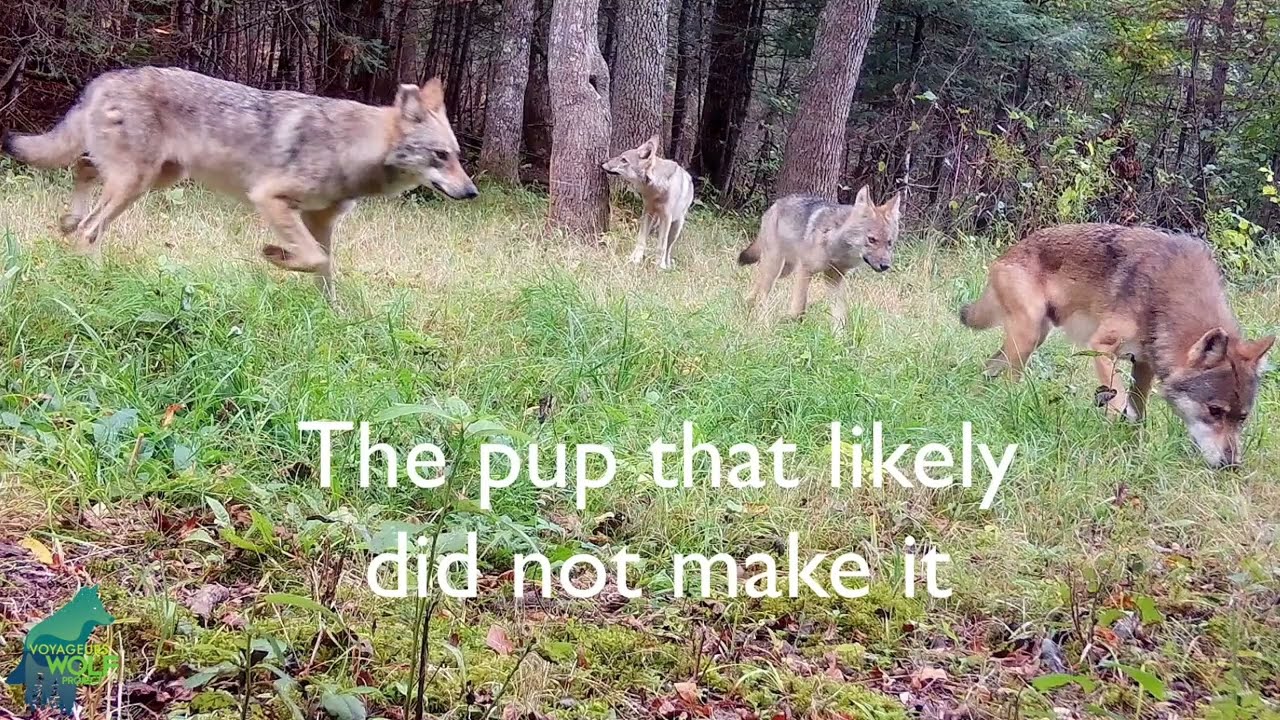
Many wolf pups don’t make it past late summer and fall, which is a often a dire time for growing wolf pups that need an increasing amount of food. This footage of the Whiskey Point Pack from this fall helps illustrate this.
The Whiskey Point Pack is just a breeding pair as they had no pups survive last year. This year appears to be a different story.
As you can see in the footage, the breeding pair successfully raised 5 pups through mid-September this year. When we first saw the pups on camera, we thought they looked somewhat small, especially relative to the adults.
We then got some footage of one of the pups 3.5 weeks later. The pup was clearly emaciated, gaunt, and very thin, with its hip/pelvis clearly protruding and visible.
You can see how different this pup’s physical appearance is relative to its other 4 siblings which were captured on camera only 4 days later…
Seeing a pup in rough condition in fall is not uncommon or surprising. In reviewing patterns of wolf pup survival, Fuller et al. (2003) concluded:
“Wolf pups in most areas survive well through summer…Autumn can be a critical period as pup food requirements are maximized (Mech 1970)…it is usually fall, rather than summer, when pups starve”.
The reason pups starve is because their parents and other pack mates are not able to catch and kill enough food to feed themselves and the pups.
One researcher feeding young captive pups noted that when pups were fed 3 pounds of food per day they lost weight and were not able to grow normally but when fed 3.5 pounds per day they grew normally.
In other words, there appears to be a relatively small margin between pups getting sufficient food and thriving, or insufficient food and struggling.
Unsurprisingly, the weight of pups in late summer and fall is a pretty good indicator of the odds that a pup will survive. Pups that are underweight have reduced probability of survival and vice versa.
A study in northeastern Minnesota compared the weight of wild wolf pups in summer and fall to the weights of pups that were raised in captivity and fed well.
They found that wild pups that were within 20% of the average weight of their captive counterparts generally survived but those that were 35% below the weights of their captive counterparts rarely survived.
Moreover, they determined that less than 15% of wild pups in September were within 20% of the body weight of captive pups (i.e., most wild pups in September were substantially underweight). However by mid-to-late October almost all wild pups still alive were within 20% of the weights of captive pups.
This pattern was likely because most pups that were substantially underweight in September died in September or early October and so the only pups still alive by the end of October were the ones that were of sufficient weight in the first place.
All this to say, that Whiskey Point pup in such poor condition in early October had very low odds of making it, and we suspect the pup likely died in October.
By mid-October, we only observed 4 pups in the Whiskey Point Pack. It is always possible that there is another pup we did not detect so we will have to confirm once we check cameras this winter but we think this is unlikely.
For perspective, the Whiskey Point Pack successfully rearing 4 pups is above average as most packs in our area only rear about 2 pups to adulthood on average.
We only have footage in hand through mid-October (other footage is still in the camera!), and there is still a possibility that some of the remaining 4 pups will not make.
As we noted above, some of the pups looked fairly small to us relative to other pups, even though they clearly were not as gaunt as their sibling. But we will have to see how many wolves are still alive once we check cameras.
Sources referenced in this post:
Fuller et al. 2003. Wolf population dynamics chapter in the book “Wolves: behavior, ecology and conservation” edited by L. D. Mech and L. Boitani.
Van Ballenberghe and Mech. 1975. Weights, growth, and survival of timber wolf pups in Minnesota. Journal of Mammalogy 56: 44-63.
Kuyt. 1972. Food habits of wolves on barren-ground caribou range. Canadian Wildlife Service Report.
Gable et al. 2023. Differential provisioning roles, prey size, and prey abundance shape the dynamic feeding behavior of gray wolves. Communications Biology.
Learn more about the Voyageurs Wolf Project:
Website: http://www.voyageurswolfproject.org
Facebook: http://www.facebook.com/VoyageursWolfProject
Instagram: http://www.instagram.com/voyageurswolfproject/
Twitter: http://www.twitter.com/VoyaWolfProject
Threads: https://www.threads.net/@voyageurswolfproject


Comments are closed.