
Steven Pinker on Language | Big Think
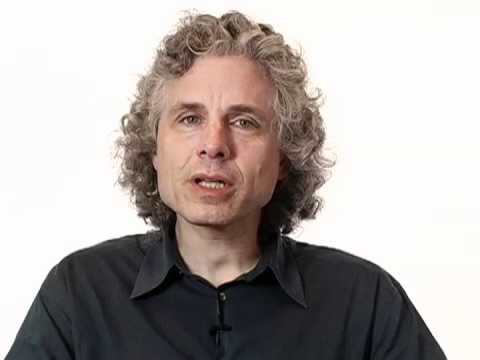
Steven Pinker on Language
New videos DAILY: https://bigth.ink
Join Big Think Edge for exclusive video lessons from top thinkers and doers: https://bigth.ink/Edge
———————————————————————————-
Free will exists, but by no means is it a miracle.We use “free will” to describe the more complex processes by which behavior is selected in the brain. These neurological steps taken to make decisions respect all laws of physics.”Free will wouldn’t be worth having or extolling, in moral discussions, if it didn’t respond to expectations of reward, punishment, praise, blame,” Pinker says.
———————————————————————————-
STEVEN PINKER:
Steven Pinker is an experimental psychologist who conducts research in visual cognition, psycholinguistics, and social relations. He grew up in Montreal and earned his BA from McGill and his PhD from Harvard. Currently Johnstone Professor of Psychology at Harvard, he has also taught at Stanford and MIT. He has won numerous prizes for his research, his teaching, and his nine books, including The Language Instinct, How the Mind Works, The Blank Slate, The Better Angels of Our Nature, The Sense of Style, and Enlightenment Now: The Case for Reason, Science, Humanism, and Progress.
———————————————————————————-
FOLLOW BIG THINK:
📰BigThink.com: https://bigth.ink
🧔Facebook: https://bigth.ink/facebook
🐦Twitter: https://bigth.ink/twitter
📸Instagram: https://bigth.ink/Instragram
📹YouTube: https://bigth.ink/youtube
✉ E-mail: info@bigthink.com
———————————————————————————-
TRANSCRIPT:
STEVEN PINKER: I do believe that there is such a thing as free will but by that I do not mean that there is some process that defies the laws of physical cause and effect. As my colleague Joshua Greene once put it, it is not the case that every time you make a decision a miracle occurs. So I don’t believe that. I believe that decisions are made by neurophysiological processes in the brain that respect all the laws of physics. On the other hand it is true that when I decide what to say next when I pick an item from a menu for dinner it’s not the same as when the doctor hits my kneecap with a hammer and my knee jerks. It’s just a different physiological process and one of them we use the word free will to characterize the more deliberative, slower, more complex process by which behavior is selected in the brain.
That process involves the aggregation of many diverse kinds of information – our memory, our goals, our current environment, our expectation of how other people will judge that action. Those are all information streams that affect that process. It’s not completely predictable in that there may be random or chaotic or nonlinear effects that mean that even if you put the same person in the same circumstance multiple times they won’t make the same choice every time. Identical twins who have almost identical upbringings, put them in the same chair, face them with the same choices. They may choose differently. Again, that’s not a miracle. That doesn’t mean that there is some ghost in the machine that is somehow pushing the neural impulses around. But it just means that the brain like other complex systems is subject to some degree of unpredictability. At the same time free will wouldn’t be worth having and certainly wouldn’t’ be worth extolling in world discussions if it didn’t respond to expectations of reward, punishment, praise, blame.
When we say that someone – we’re punishing or rewarding someone based on what they chose to do we do that in the hope that that person and other people who hear about what happens will factor in how their choices will be treated by others and therefore there’ll be more likely to do good things and less likely to do bad things in the expectation that if they choose beneficial actions better things will happen to them. So paradoxically one of the reasons that we want free will to exist is that it be determined by the consequences of those choices. And on average it does. People do obey the laws more often than not. They do things that curry favor more often than they bring proprium on their heads but not with 100 percent predictability. So that process is what we call free will. It’s different from many of the more reflexive and predictable behaviors that we can admit but it does not involve a miracle.


@robertobecerrabravo1448
April 17, 2026 at 5:37 pm
3:47
@ivisionaries1.618
April 17, 2026 at 5:37 pm
Shandar ….👍
You are genius
…no…doubt
@logos2395
April 17, 2026 at 5:37 pm
A model Canadian-American abomination, a propagandist of total cretinism
@Orf
April 17, 2026 at 5:37 pm
3:47
@teamimani6301
April 17, 2026 at 5:37 pm
Here in 2020 during COV-19, a time when language is more important then ever before.
@finegoldstones
April 17, 2026 at 5:37 pm
Thanks
@astarbhatti3496
April 17, 2026 at 5:37 pm
Thanks sir give me refers to how language works
@marcverhaegen7943
April 17, 2026 at 5:37 pm
For an update of how human speech & language evolved, google "Speech originS Verhaegen PPT".
@timgeurts
April 17, 2026 at 5:37 pm
3:48 – lol was 2012 so bad?
@abhaysharma3394
April 17, 2026 at 5:37 pm
i am a trilingual, but i still wanted to learn some more languages i think there is no better mental task then learning a different language.
@jaymepereiranunes
April 17, 2026 at 5:37 pm
jesus christ, im so stupid, i couldnt understand 1% what he said… gotta acquire more language somewhere.
@NassNassKPB
April 17, 2026 at 5:37 pm
I wouldn't say that its instinctive but they can convey meaning, description and a wide variety of things something I think is intrinsic to the human language
@braunblender
April 17, 2026 at 5:37 pm
i was reading today in a new scientist article that they taught chips simple 4 letter words with meaning and got them to categorise them then showed them real 4 letters word they never seen and fictional 4 letter words they never seen and they were able to correctly categorise the real and made up words. . thought that was quite intresting