
September Philosophy Reading Recommendations !
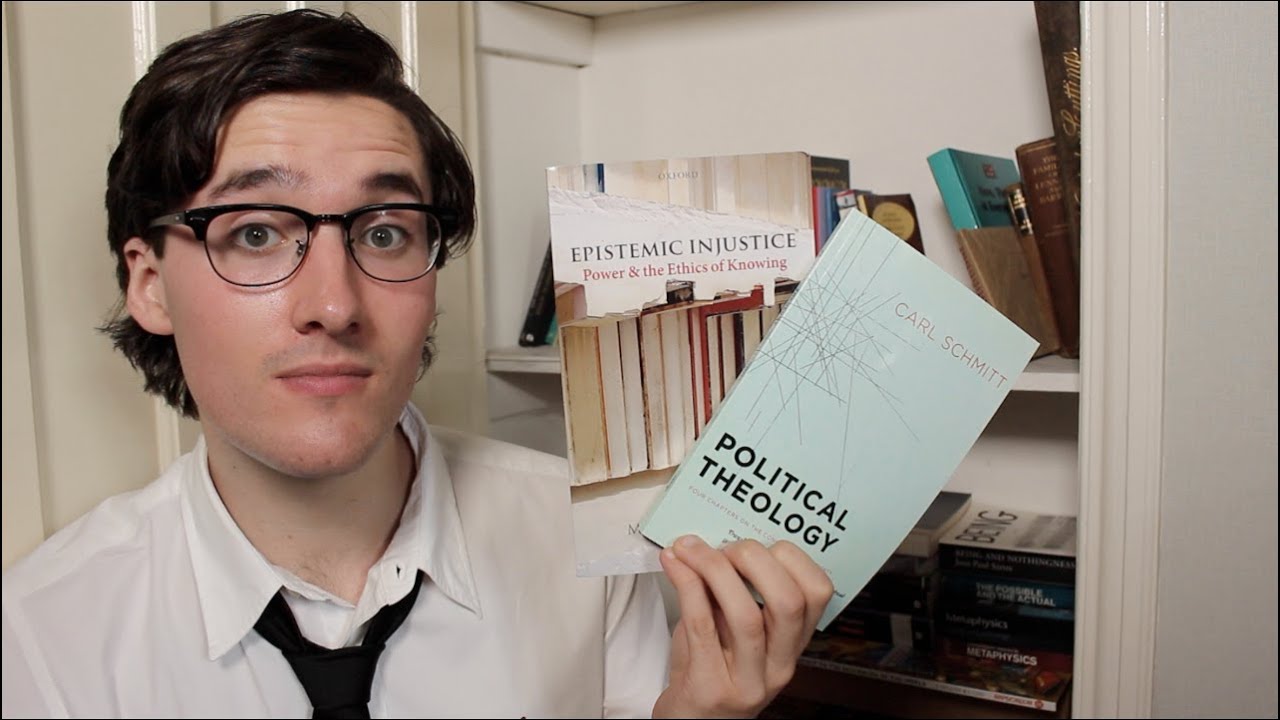
More philosophy books! Ludwig Wittgenstein on colour; Carl Schmitt on politics, God, religion, and why he was a Nazi; and Miranda Fricker on the link between knowledge and ethics.
Subscribe! http://tinyurl.com/pr99a46
Patreon: http://www.patreon.com/PhilosophyTube
Audible: http://tinyurl.com/jn6tpup
FAQ: http://tinyurl.com/j8bo4gb
Facebook: http://tinyurl.com/jgjek5w
Twitter: @PhilosophyTube
Email: ollysphilosophychannel@gmail.com
Google+: google.com/+thephilosophytube
realphilosophytube.tumblr.com
Recommended Reading:
Miranda Fricker, “Epistemic Injustice: http://tinyurl.com/je7lsoq
Wittgenstein, “Remarks on Colour” http://tinyurl.com/zvkd9jt
Carl Schmitt, “Political Theology” http://tinyurl.com/z65ext3
Glow shine animation by AAVFX: https://www.youtube.com/watch?v=yNAaC4qXVyQ
Music by Epidemic Sound (Epidemicsound.com)
If you or your organisation would like to financially support Philosophy Tube in distributing philosophical knowledge to those who might not otherwise have access to it in exchange for credits on the show, please get in touch!
Any copyrighted material should fall under fair use for educational purposes or commentary, but if you are a copyright holder and believe your material has been used unfairly please get in touch with us and we will be happy to discuss it.


@rauldjvp3053
August 25, 2025 at 11:41 am
I spy with my little eye Julia Serrano.
@tumbleweed1997
August 25, 2025 at 11:41 am
The books are actually in alphabethical order! It's like a mini library. This is the cutest and funniest thing I've ever seen!
@MrMikkyn
August 25, 2025 at 11:41 am
I can’t read Schmitt, he seems very nihilistic. Same with Sartre. Nietzsche is megalomaniacal. But the first and the third are extremely important for me to study.
@antonidamk
August 25, 2025 at 11:41 am
Can I just say, I have been dying from a migraine all morning, unable to do much of any use, but just about able to listen to something. You would never think video essays about philosophy would be the choice in those circumstances, but honestly they have been positively soothing… Thank you as always.
@Firmus777
August 25, 2025 at 11:41 am
Awful misreading of Schmitt. He does not analyse the problems with the political, he describes what the political is. Those things that you see as problems is what the political is and as long as there is something political certain characteristics that are analysed are going to be present.
By trying to escape all those aspects of political reality, you are being liberal. Liberalism is precisely the negation of the political, the negation of the friend-enemy distinction, the running away of any serious life or death conflicts. Liberalism is the thing that Schmitt finds problematic, not the political. You have to accept political reality in order to achieve any sort of a goal, if you ignore it and turn to liberalism then you are destined to either fail or fall to hypocrisy.
Reading Schmitt in order to dismantle the political is a very bad leftist reading of Schmitt that just comes down to liberalism. A good leftist reading of Schmitt would be reading him in order to apply his theories to 1) class struggle and 2) leading a socialist state.
@TheDancingHyena
August 25, 2025 at 11:41 am
schmidt is the original selfawarewolf
@heistself
August 25, 2025 at 11:41 am
It's ironic that only a few minutes after noting the personal significance of Fricker's work, given the responsibility associated with his role as an educator, Olly goes on to make a series of misleading claims about Wittgenstein, the result of which is a gross mischaracterization of the latter's work. OOF!
@kwekvonscaf
August 25, 2025 at 11:41 am
3:02 Yo Olli, did you actually read Schmitt? Cause I don't get some of your ideas on him? Maybe I read it wrong?
I'm not a philosophy student and I don't consider myself to be really good at it. But I just finished the same book this week. I started reading "The concept of the Political" , "The theorie of the Partisan", "The Crisis of Parliamentary Democracy" and finished "Political Theology" yesterday. I'm going to do "Political Romanticism" next. I started reading that stuff, partially because of one your videos and mostly because of a new found fascination with the extreme right ideology. Which I apperently didn't understand that well, but I'm trying to get there.
Schmitt all the way till 1932 really didn't go "Let's all be NAZI's about it". In 1932 he wrote a book called "Legality and Legitimacy", where he wants to ban "non-constitutional-parties" out of Weimar Parlement. Because he was afraid they would destroy "the sovereign". He finds it strange that a parlement would allow a party that in their core program want to destroy the institution that it wants to obtain power of.
I had a course in Hobbes by a professor who did his doctorat on Hobbes. And I had a conversation with him once, that Hobbes has this idea that once you have a sovereign, and the contract is signed between him and the populus, the sovereign protects the people but the people in return need to give "absolute" devotion to the sovereign. I argued that this is highly problematic once a violent dictator comes into power… and now years later I actually found my case study. Schmitt is drenched in Hobbes' logic, he almost had the same traumatising background as Hobbes too. Hobbes wrote from a fear of dis-order because of wars. A fear that the ruling class didn't take care of it's people. That's why he wants to create this contract between the ruling class and those that are ruled. For protection, order and safety. People according to Hobbes are cruel and wage war against eachother. Schmitt grew up during the 1st world war and all the troubles it created for Germany. He found reason in Hobbes. During the Weimarr republic his writings are critical for progressive liberalism and socialism, because he was a conservative christian. But he still recognised the republic as being the soevereign, and because of this Hobbesian idea he needed to be totally devoted to the sate. But he still criticised the contradictions in liberalism and warned for the failure of democracy. But "warning" someone is not the same as "embracing dictatorship". In 1933 when the NAZI party obtained full power, he had no choice in his Hobbesian framework then to turn to the new Soevereign, and he devoted himself to the NAZI party (got membership). He wrote some awfull antisemitic texts not to mention a text on the "night of the long knifes" in 1934 when some of his collegues got murdered off in the cleansing of the NAZI party. He acquired high functions and got thrown out of the party in 1936 because of a critical text that he wrote on the SS. Apperently he had friends in high places (Like H. Goering), cause he survived. I've not read his idea on the NAZI party, apperently he wrote a book about it after his captivity in 1948. But I'm considering reading his entire work, it's really fascinating from a political stance.
What he did, was inexcusable. But when he wrote "Political Theology" he was actually warning for extremes and the problems of liberalism. In the concept of the political he expresses that he fears that "liberalism" would lead to indiffrence (the lost of "ernst" which means "seriousnes"). He saw politics as something to be serious about, and to watch out for but liberalism tries to neutralise the political, which he found problematic. I had some problems with his view on "parliamentary democracy" but a lot of the issues in that one still hold up today and are still discussed in political science books. The Pathos of Liberalism (like he calls it) was recently expressed by a political economist called "Mark Blyth" he wrote on Lockes' idea of liberalism: "[The State]… you need it. You can’t live without it. You don’t want to pay for it.". Which is pretty much the same problem Schmitt has with it. But he doesn't just talk affordability, he talks about "political power". You need a state with power, but you need to make sure the state is unable to really use it.
By the end of the book… he discusses "traditionalism" who want to conserve political frameworks from the middle ages. They believe in absolute rulers (Traditionalism, is also a political stream that influenced fascism). He discusses the problems in their thinking, because they believe in strong governement. And he finds a strangeness: that "Anarchists" and "Traditionalists"/"Descisionists" make the same evaluation of the liberal system, they point at the same problems BUT they give diffrent answers. He also discusses that it comes from a fundamental starting point in thought, which is about their idea on the nature of human beings.
He ends mocking the paradox in Bakunins' ideas, who (according to schmitt) became the theologian of atheists and the dictator of anarchists.
I enjoyed all Schmitts books so far… but in nothing that I read I had the interpretation that he was rooting for dictatorship. But as a Hobbesian and a realists (cause he's not really that concerned about morality, he is concerned of what is going on and what is declared law) he had to be devoted to his ruler. Which was quite a problem if the sovereign becomes the NAZI party. Schmitt also seems to be a crash course in ideas that lingered in the 20s and his negative ideas on parlement aren't that strange for that time (Most of the criticism still hold some truth today). Look at Robert Michels who developed "the iron law of oligarchy" , he got so disillusioned by parliamentary democracy that he also joined the NAZI party later on in life.
@jules6631
August 25, 2025 at 11:41 am
TFW Olly owns one of the books you had to read for summer reading
@thesilvercell
August 25, 2025 at 11:41 am
Sometimes, I just get distracted by your cuteness and find myself just staring at you talk instead of listening to what you're saying. Thank goodness this is Youtube.
@AntipodalBrink
August 25, 2025 at 11:41 am
Serano! =-3
@herewardthewake2636
August 25, 2025 at 11:41 am
Which court in the western world disregards someone because they're not white and male? Some intelligent criticism would be in order. It would probably be more accurate to say that white males are discriminated against in court (particulary in rape cases).
@theprivateer83
August 25, 2025 at 11:41 am
Read Carl Schmitt and be saved
@coffee221b
August 25, 2025 at 11:41 am
Please, talk about anarchism?!
@brazwen
August 25, 2025 at 11:41 am
I see you have "Necronomicon".
@geminisonar9979
August 25, 2025 at 11:41 am
I lik philosophy but I don't understand much and then I have to go and do wiki again, it becomes tiresome, can you make a video on beginners reading list
@silveranstavern
August 25, 2025 at 11:41 am
I wonder about your thoughts on the following top 10 philosophical works
The top 5 list:
Plato's Republic
Augustine's City of God
Thomas Aquinas' Summa Theologiae
Rene Descartes' Meditations
G.W.F. Hegel's Phenomenology of Spirit .
The other 5 — to make it a top 10:
Aristotle's Metaphysics
Blaise Pascal's Pensees
Martin Heidegger's Being and Time
Max Scheler's Formalism in Ethics
Maurice Blondel's Action (1893)
@jasonmares9363
August 25, 2025 at 11:41 am
Can anyone recommend any books that tackle concepts of peace?
@Mastattak
August 25, 2025 at 11:41 am
Don't get me wrong, I'm here for the content of the videos.
But sweet jesus he's hot.
@kodomortem3155
August 25, 2025 at 11:41 am
Thanks Ollie! Whats your opinion on 'Cuckoldry for Dummies'? You're credited quite a bit in it.
@sunnyrainyday6820
August 25, 2025 at 11:41 am
in terms of Carl Shmits' and basically Political Philosophy and how some people are included and excluded is basically like being human. in moral and Political philosophy there is usually a confusing line that exists somewhere that needs to be drawn to retain humanity or protect the countries ideals and values. the human body is controlled by a single consciousness thing and that is really similar to the idea of a king or dictator but we as humans want to identify as something, to know who we are and one of the ways to do that is to uphold some philosophy or some idea like its the final stage of Kierkegaard's moral ladder or define our self by what we are not which is much simpler, gives a lot more freedom and give you something to fight which is always fun.
@maurici_ohs
August 25, 2025 at 11:41 am
What kind of books would you recommend for anyone who's just discovering their interest in philosophy?
@kanewilliams3613
August 25, 2025 at 11:41 am
How many books do you go through a month?
Comments are closed.