
Interview: Dark Matter and Black Holes with David Kaiser | Particles of Thought
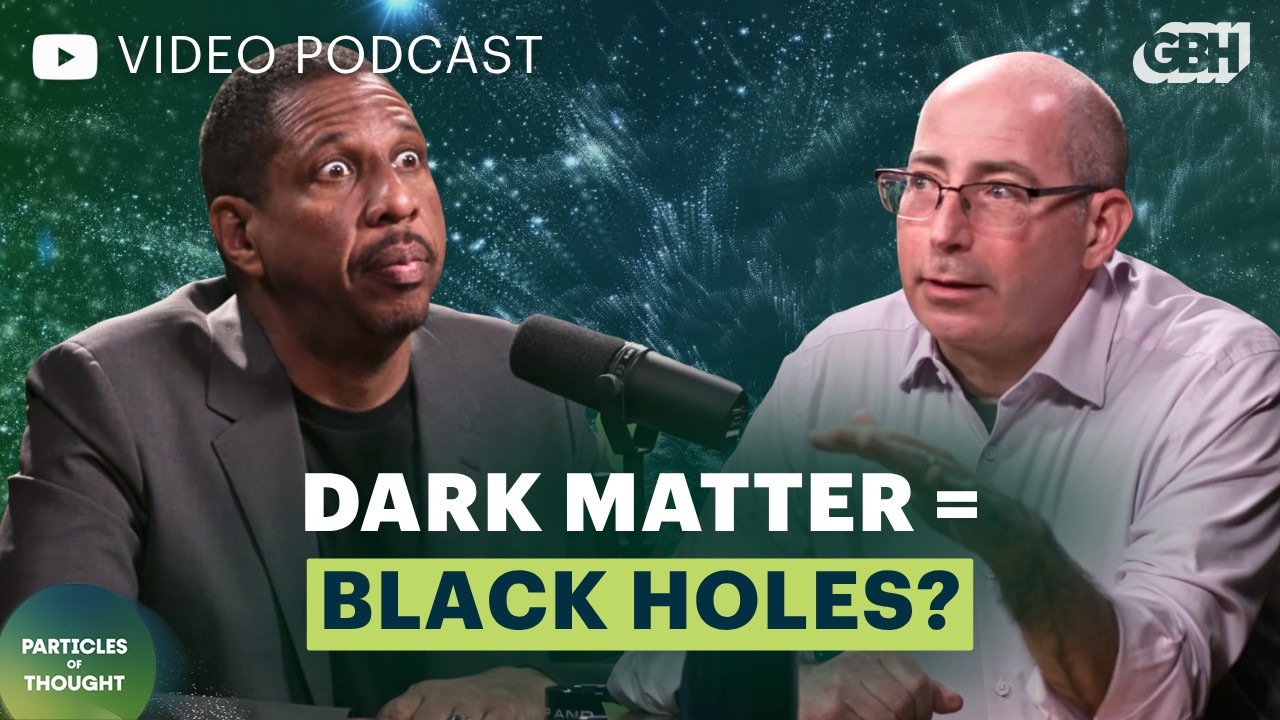
Dark matter is an impossible physics puzzle, and nearly a century of observations has yet to reveal what it actually is.
Particles of Thought is back for Season 2!
🎧 Available on your favorite podcast platforms
Amazon Music: https://bit.ly/4msqqby
Spotify: https://bit.ly/3Hz8rkI
Apple Podcasts: https://apple.co/4oB3Ten
If you enjoyed this podcast, please consider leaving a rating and review on Apple Podcasts. Your feedback helps new listeners find the show and allows us to continue creating great science content. Thank you for your support! https://podcasts.apple.com/us/podcast/particles-of-thought/id1832615266
⭐️⭐️⭐️⭐️⭐️
David Kaiser thinks the dark matter puzzle is getting closer to being solved. Nearly a century of observations, from galaxy clusters to the cosmic microwave background, have built a compelling case for dark matter’s existence, but in recent years, the leading candidates for this mysterious matter have been coming up short.. Enter black holes. Tiny ones. David explains how so-called primordial black holes that formed in the first moments after the Big Bang could possibly be all our dark matter… if they exist at all. Fortunately, this is a testable theory, and David explains the exciting new experiments that could potentially lay this cosmic mystery to rest.
David Kaiser is a professor of physics and the history of science at MIT. His research spans the history of modern physics, cosmology, and the foundations of quantum theory. He is the author of several books, including How the Hippies Saved Physics, and is a frequent contributor to public conversations about science and its history. He is also featured in NOVA’s documentaries Einstein’s Quantum Riddle and Decoding the Universe.
Chapters
00:00:00 The History of Dark Matter
00:26:56 What are Primordial Black Holes?
00:57:04 Detecting Primordial Black Holes
01:23:09 Credits
📰 Stay up to date on the latest science discoveries, full episodes, articles, videos, and more by signing up for NOVA’s newsletter here: https://to.pbs.org/4brCC7Y
▶️ Stream NOVA documentaries & more with PBS Documentaries on Prime Video: https://amzn.to/4hXBlsu
💙 Help us bring the universe closer to home. Your donation ensures that NOVA’s deep-space discoveries and quantum physics explorations remain free and inspiring for the next generation of scientists. Support fact-based storytelling today. https://bit.ly/48UnsrD
🌟 Follow on social for more NOVA content
Twitter: https://twitter.com/novapbs
Instagram: https://www.instagram.com/novapbs
TikTok: https://www.tiktok.com/@novapbs
#podcast #astrophysics #darkmatter #blackholes
Comments
Latest news


@Andre-ft6wx
June 19, 2026 at 1:55 pm
Dark matter is gravity. And gravity doesn’t pull objects with mass it pushes in on them.
So sayeth Eholeio.
@OM4Rx
June 19, 2026 at 1:55 pm
Great video!
@joshjosh575
June 19, 2026 at 1:55 pm
Temu Niel Degras Tyson.
@JoshuaMallory
June 19, 2026 at 1:55 pm
And here I am thinking gravity is an emergent property of dark matter
@BW-xz6ol
June 19, 2026 at 1:55 pm
Not your who’s what?
@MrDoughintz
June 19, 2026 at 1:55 pm
This is such a fascinating topic. Another great episode.
@robertbosc4422
June 19, 2026 at 1:55 pm
…..C12
1oVe
R
N
@J0hnC0ltrane
June 19, 2026 at 1:55 pm
You've changed your studio set!
@LordSlag
June 19, 2026 at 1:55 pm
40
@geoffreyah
June 19, 2026 at 1:55 pm
The Chandrasekhar limit over rides the Schwarzswhild radius. One needs a huge mass to make black holes. Consequently, there are not such thing as microscopic black holes.
@shawns0762
June 19, 2026 at 1:55 pm
Mass that exists at relativistic velocities is irrelevant from our perspective. Relativistic velocities are occurring in the overwhelming majority of galaxy centers. This means that they exist in a "non local" state relative to their outer regions. The mass in our galactic center is not just there, it's everywhere.
Einstein repeatedly said that Relativistic dilation (gamma) prevents astronomical concentrations of mass/singularities. He put this in writing in 1939. Nobody believed in singularities until television and movies popularized them.
There is mass that is relevant from our perspective and there is mass that isn't. Galaxy rotation curves show the gravitational effects of both.
Relativistic dilation doesn't occur in galaxies with low mass centers. They don't have enough mass to achieve relativistic velocities. Therefore all their mass is relevant from our perspective.
It has been confirmed in 25 dwarf and ultra diffuse galaxies including NGC 1052-DF2 and DF4 to have no dark matter. In other words they have normal rotation rates. There is no doubt in my mind that all such galaxies have normal rates. Relativistically dilated mass cannot be observed as a particle.
@HidingInTheClouds
June 19, 2026 at 1:55 pm
such an interesting conversation! really love how enthusiastic both the host and the guest are. them playing off of each other towards the second half and "nerding out" about astrophysics was such a joy to witness. thank you!
@torch_k8110
June 19, 2026 at 1:55 pm
Nice, I’ve been waiting for a new episode
@AllenProxmire
June 19, 2026 at 1:55 pm
if I said this stuff, you'd call me crank. because it is.
@ryansavage775
June 19, 2026 at 1:55 pm
Matter passing through dark matter doesn't make the matter annaliate into light. If dark matter was anti matter, it would. Dark matter is likely more condense clouds of gravitons, or where gravitational waves collide a lot like larger waves in wave pools. A big bang would create some massive wave pockets that hasn't settled yet. Like if the wave machine in the pool stopped, waves would still be in the pool for a period of time. The Lisa telescope should add some data. 2035
@johnathanteal
June 19, 2026 at 1:55 pm
So dark matter interacts gravitationally but not electro magnetically. What if…. Dark matter is missing graviton?
@JoeyjjShabadu
June 19, 2026 at 1:55 pm
The title on the thumbnail (thumbnail, not the paused video) is a surprisingly juvenile joke by PBS standards. But hey, it got me to click on the vid to comment, so mission accomplished I guess?
@qbtc
June 19, 2026 at 1:55 pm
So the supermassive black hole at the center of our galaxy named Sagittarius A* could be a dark matter core and not a black hole at all because they are equivalent observationally. And all or the majority of dark matter could be primordial black holes on the scale of atoms. Let that sink in.
@Chirokelley
June 19, 2026 at 1:55 pm
Physics is basically conjecture at this point. What if … We are limited in our ability to perceive (and measure) dimensions that are, by definition, “beyond our reality”?
@hannesluettringhaus1615
June 19, 2026 at 1:55 pm
I have been wondering myself about the possibility that dark matter are just black holes. But how would that correspond to the Hawking radiation? I understood that very small black holes are evaporation really fast. After 14 bn years they should be all gone.
@alexandragrace8164
June 19, 2026 at 1:55 pm
Wonderful conversation! More!! ❤😊😊
@crambotted
June 19, 2026 at 1:55 pm
Woohoo!
@2STETHOSCOPES
June 19, 2026 at 1:55 pm
Nice Suit Dr.O
@freshbackin86
June 19, 2026 at 1:55 pm
Took a screenshot of the original 'Grandma's Black Hole' thumbnail for historical purposes
@2STETHOSCOPES
June 19, 2026 at 1:55 pm
Yaaaaaaay!!! We need more frequent episodes! More Dr.O
@ALEXEI-c1b6l
June 19, 2026 at 1:55 pm
Brilliant conversation !
@HamsterClamper
June 19, 2026 at 1:55 pm
Oh no, Mr Shouty🙁
@EddieCaplan
June 19, 2026 at 1:55 pm
Interesting topic and guest. But after 5 minutes I had to stop listening because the host keeps making an unending series of annoying sounds. "Uh huh". "Yeah". "Mmm". Would you please STFU so I can listen to your guest?!
@AlienNihilist
June 19, 2026 at 1:55 pm
Your thumbnail quote is disgusting and offensive. F nova!? What's wrong with you? Have you gone MAGA?
@mcmc2386
June 19, 2026 at 1:55 pm
Published in 2004
@rajkumarramraj5391
June 19, 2026 at 1:55 pm
OMCS! OMCS! OMCS! [OH MY CARL SAGAN] New episode! Yeeeeah… Still bum though that this is a limited 10 episodes podster with only one more to go. Please consider continuing this indefinitely.
@statebased
June 19, 2026 at 1:55 pm
Exhorbitant eyes, the new new in science communication! 😂😢
@MrBrukmann
June 19, 2026 at 1:55 pm
Just because eyes bugging out of your head is clickbait doesn't make it not racist. Do better.
@KreakritP
June 19, 2026 at 1:55 pm
How care monster government since spending system money technology space among don't care AI around the world
@SeattleWhovian
June 19, 2026 at 1:55 pm
When I learned neutrinos have mass fairly recently, the first thing I wondered was, "How do we know neutrinos aren't 'dark matter'?"
@Wisconsin_Gardener
June 19, 2026 at 1:55 pm
Came for answers, left with more questions.
@TheBryanmauro
June 19, 2026 at 1:55 pm
I thought we were talking about grandma's black hole? What this about physics?
Comments are closed.