
E.O. Wilson: Synthetic Biology Will Radically Change the World | Big Think.
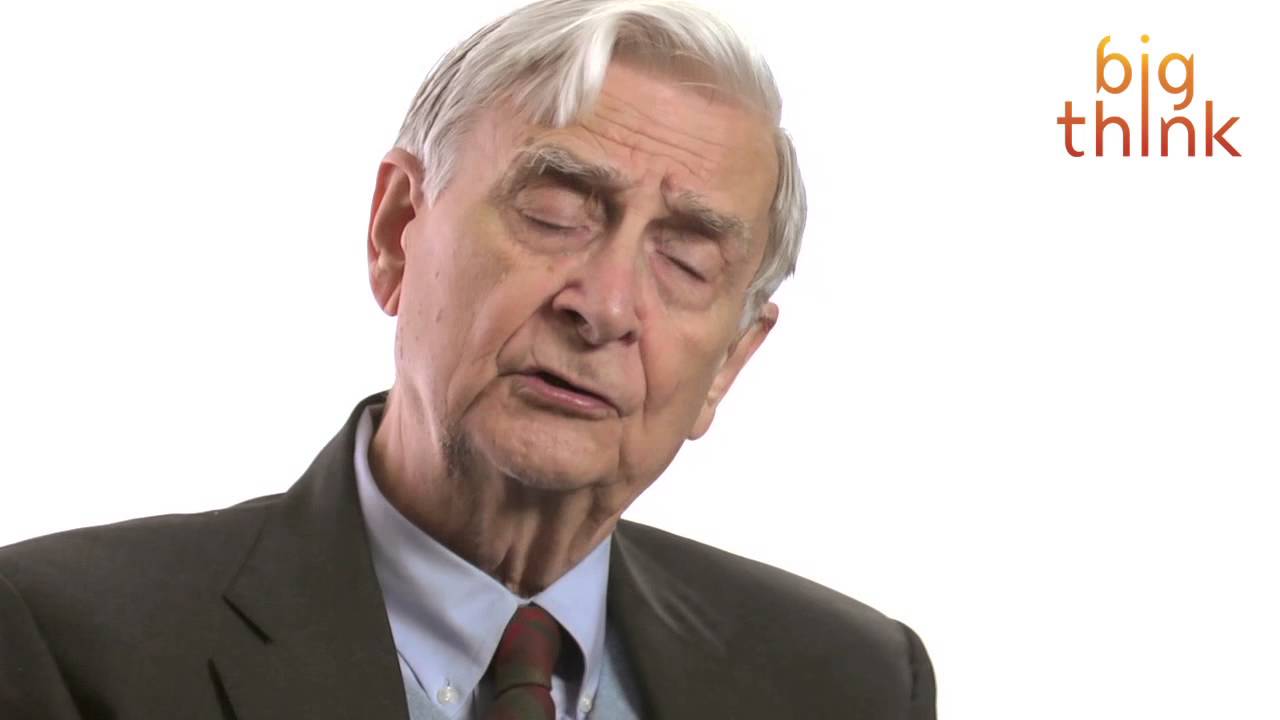
Synthetic Biology Will Radically Change the World
Watch the newest video from Big Think: https://bigth.ink/NewVideo
Join Big Think Edge for exclusive videos: https://bigth.ink/Edge
———————————————————————————-
Legendary biologist Edward O. Wilson explores three realms of ultimate biology from which we should expect major breakthroughs over the next several decades. Each is rooted in synthetic biology, which makes the creation of artificial life possible. Wilson’s latest book is titled “The Meaning of Human Existence.”
———————————————————————————-
EDWARD O. WILSON:
Edward Osborne Wilson is an American biologist (Myrmecology, a branch of entomology), researcher (sociobiology, biodiversity), theorist (consilience, biophilia), and naturalist (conservationism). Wilson is known for his career as a scientist, his advocacy for environmentalism, and his secular humanist ideas concerned with religious and ethical matters.
A Harvard professor for four decades, he has written twenty books, won two Pulitzer prizes, and discovered hundreds of new species. Considered to be one of the world’s greatest living scientists, Dr. Wilson is often called “the father of biodiversity,” (a word that he coined). He is the Pellegrino University Research Professor, Emeritus in Entomology for the Department of Organismic and Evolutionary Biology at Harvard University and a Fellow of the Committee for Skeptical Inquiry. He is a Humanist Laureate of the International Academy of Humanism.
———————————————————————————-
TRANSCRIPT:
E.O. Wilson: I like to think that ultimate biology, ultimate biology is going to emerge within the next several decades and it’s going to be in three domains. One has already begun. And that is the creation of artificial life. And scientists have just very recently put together, from chemicals off the shelf, a genome that is of the entire DNA of a bacterium, inserted it into a bacterial shell and created a functioning reproducing bacterium that way; chemicals off the shelf; a very simple organism. Now this is momentous because it means that as we develop this technology, we’re going to eventually be able to produce multicellular organisms and new kinds of species. We’ll have that capacity and it’s going to raise all kinds of questions, certainly opportunities. And among the opportunities that it will present, if we don’t let the excesses and the deviations and auxiliary consequences unforeseen overwhelm us, is that we’re going to be able to produce improvements in the productivity of our food plants and organisms that are vital for the maintenance of human-dominated environments.
I say that in that way because I also believe it’s going to be absolutely necessary for the welfare of planet Earth that we leave a large part of the planet to the 8 million other species that occupy Earth with us because that’s the shield that already is in place to which we are exquisitely well adapted. But that’s called, that creation of life is called synthetic biology and mark it well. Synthetic biology is just taking off and it means it’s going to have an impact in a lot of ways. And it will segue in its consequences and what it reveals about the nature of life and humanity itself as it comes into the era of artificial intelligence and robotics in a big way.
There is ongoing at the present time, I know I just met with a number of them, something of a controversy between the artificial intelligence and humanoid robotic creators, a controversy over whether we’re going to duplicate the brain digitally. Most think that that can be done. That’s not exactly how neurons really work; they work en masse in creating waves of activities that then trigger other waves, hormonal release, and so on. But against that viewpoint also exists the analog robotic thinkers who believe the human brain is just so thoroughly analog and that it doesn’t really work digitally, but it works on activation of masses of neurons, layers, loci, and web work that passes varying degrees subjectively felt through other pathways and centers until finally they reach decision points, mostly in the subconscious brain. So we have coming ahead in the development of these various fields the capacity, one, to immensely alter, once we know the full genomes and artificial intelligence, when synthetic biology is advanced, profoundly alter food plants and almost create new ones that can substantially increase the per capita food supply of the world with enormous consequences.
And then on the other hand we have the capacity in time of producing robots that can think like humans and on much lower …
To read the transcript, please go to https://bigthink.com/videos/eo-wilson-on-synthetic-biology


@gabrielbaky1635
November 4, 2025 at 3:32 pm
This is literally my job today
@rayspencer5025
November 4, 2025 at 3:32 pm
This is only "partially synthetic" biology. DNA is only part of the molecular machinery that makes a cell alive. The part being ignored is the non-genetic parts of the cell (the cell membrane and cell organelles) that are passed directly from parent to daughter cells by cell division.
@rmartin6914
November 4, 2025 at 3:32 pm
Synthetic life plus AI is the future
@ZeroXAlAttas
November 4, 2025 at 3:32 pm
How old is he, captain?
@PromethorYT
November 4, 2025 at 3:32 pm
Sometime i feel like i wasn't born into the right era. But then i realize how much the world changed and is currently changing and find this era really interesting. Even if i dream i could easily repair my nearly-cut in half left arm and restore my sensations or live longer and cure cancers. I wish i didn't had to do trivial task to eat every day and had more time to learn about our fascinating universe. I wish our current society wasn't just some kind of ''hidden'' slavery and control of the masses. But i was born in this era, so it must be the right one for me i suppose.
@Astra.Valentine
November 4, 2025 at 3:32 pm
People are always so worried about robots taking over from humans, and there are always people who say "No, no! That will never happen!" But would it really be a bad thing if they did? Think about it; it's not like people have ever freaked out about the next generation of humans "taking over." I believe that it is very likely that robots will eventually take over, in the sense that people will have fewer and fewer biological children, and robots will become more and more common, because they're easier–robots don't get sick, don't need to eat, can perform calculations at the drop of a hat, etc. Why would you want to subject your child to the chance of disease and hunger, when you could build a robot child instead?
@MyFornow
November 4, 2025 at 3:32 pm
It is topics like these that make human beings both fascinating and frightening at the same time.
@redbull5671
November 4, 2025 at 3:32 pm
Simply brilliant thinking ! Wow! Enjoyed his take on synthetic bio and how food production possibilities can be expanded in the near future and robots can be developed to aid in human tasks while also posing a danger to our dominance over our environment. Interestingly but not surprisingly though, EO Wilson does say that we need to support the biodiversity of all eight million species we share this planet with. Overall, I personally see no other choice but for humans but to expand their kind over other planets in order to survive against overpopulation and the risks of disease as well as collisions from asteroids and/or meteors and the dying of our Sun in some 6 billion years. The real benefit of inhabiting new planets is that we may chance upon new planets that will expose us to new chemistry that will hopefully extend human life, and at least offer us more territory on which to increase our chances of survival in the cosmos while bringing us closer to other extraterrestrial intelligent life that is bound (I believe) to exist in the universe. Though then, we as a species might then need to introduce biodiversity in these alien planets in order to survive while also creating political governance and enforcement of peace and prosperity to deter crime and terrorism. Inhabiting new planets will deem imperative that we create civilized societies to deter the natural violence and lawlessness that comes about when humans dominate their natural environment. All in all, the future seems to hold great mysteries that hopefully bring great adventure and prosperity to all humankind.
@zenzylok
November 4, 2025 at 3:32 pm
Now humans just need to genetically modify themselves through synthetic evolution.
@wertytrewqa
November 4, 2025 at 3:32 pm
It sounds like they are trying to make life like it is on earth but it would be even more interesting for them to make life unlike that on earth.
@Neueregel
November 4, 2025 at 3:32 pm
good talk
@JesusSkateboardsdotnet
November 4, 2025 at 3:32 pm
what substance is the "shell" made from that houses the chemicals for this synthetic bacterium..?
@mathlind
November 4, 2025 at 3:32 pm
Regarding artificial intelligence, unfortunately we won't be restrictive when it comes to developing AI for warfare. Although the consequences of a global nuclear war would be disastrous, we are still gladly building nuclear weapons. Why would we suddenly become wise.
@50andURnotLOLOLOL
November 4, 2025 at 3:32 pm
It's a very exciting time to be alive
@AnthonyJD94
November 4, 2025 at 3:32 pm
I've heard a lot of people and scientists talking like this recently and I don't understand whether I'm just an idiot or something; I just can't see what basis these scientists have for believing that the creation of artificial intelligence is in any way possible. As far as I understand it's a flawed idea from the beginning; we identify intelligence with subjectivity, so how does one program or create subjectivity. I'm not trying to be a dick or anything, if anyone has some genuine answers which may help me I'd love to hear.
@Farfromhere001
November 4, 2025 at 3:32 pm
No.
@daniell9330
November 4, 2025 at 3:32 pm
Of all the possible futures we will end up with Blade Runner?
@TravisOrbin
November 4, 2025 at 3:32 pm
Can I have a never-ending supply of pho?
@truedeadandlife
November 4, 2025 at 3:32 pm
You guys should see Ex Machina, coming out in US theaters in april I think. I saw it during the Gothenburg Film Festival. It speaks thoroughly regarding this topic. 10/10 IGN
@truedeadandlife
November 4, 2025 at 3:32 pm
You're cool. Being what? 80, 70 or something but still young in mind.
@cedb3360
November 4, 2025 at 3:32 pm
Agreeee with all that! Even tho he said Richard Dawkins was a journalist and that he doesnt agree with the selfish gene theory..
@luvyou-baby
November 4, 2025 at 3:32 pm
so this is how humanity are going to die
@prodipto
November 4, 2025 at 3:32 pm
Anyone know whats wrong with his eye??
@KnightsAndDarths
November 4, 2025 at 3:32 pm
Genetically engineered evolution of the Human race, is that what he's suggesting? How's that any different from being wiped out by machines? Seems to me we're just choosing different types of extinction.
@JimmyBackbeat
November 4, 2025 at 3:32 pm
I just love listening to this guy
@deepthroat212
November 4, 2025 at 3:32 pm
fuk this guy is boring!!!
@deepashtray5605
November 4, 2025 at 3:32 pm
The principles of evolution still apply.
@MrShagification
November 4, 2025 at 3:32 pm
Wow a Big Think video that doesn't have thousands of dislikes within the hour of upload.
@bludice123
November 4, 2025 at 3:32 pm
now if only we could stop killing each other over beliefs,money,power and finally get the whole world working together we might be able to keep the planet alive for more than 100 years.
@BIkaloss
November 4, 2025 at 3:32 pm
About time we created a Homunculus.
@shashanksharma479
November 4, 2025 at 3:32 pm
Why would synthetic biology be any good for welfare of planet earth ?…amazingly I think it would be good for the operations used in space research…like time travel, space travel to different planets…
@SCWoodbury2009
November 4, 2025 at 3:32 pm
Well robots might not take over us as a species, but they sure are likely to take over most common jobs.
@estebanelbeasto
November 4, 2025 at 3:32 pm
Scary shit!!!
@bruno3
November 4, 2025 at 3:32 pm
The title might as well be "How humans will screw this up".
@DremagGames
November 4, 2025 at 3:32 pm
This is what I have been saying for years .
@ammettheyellingfrog1
November 4, 2025 at 3:32 pm
Anti-GMO people won't be happy about this, but who cares what they think, they're wrong
@richardspence5093
November 4, 2025 at 3:32 pm
Here comes the matrix lol
@ko777za
November 4, 2025 at 3:32 pm
Astounding
@morganthem
November 4, 2025 at 3:32 pm
I can already see the contamination of the biome with artificial life… That kind of action could have far reaching and unpredictable outcomes.
@morganthem
November 4, 2025 at 3:32 pm
Wow
Comments are closed.