
Scientists Hope James Webb’s Latest Discovery Is a Mistake
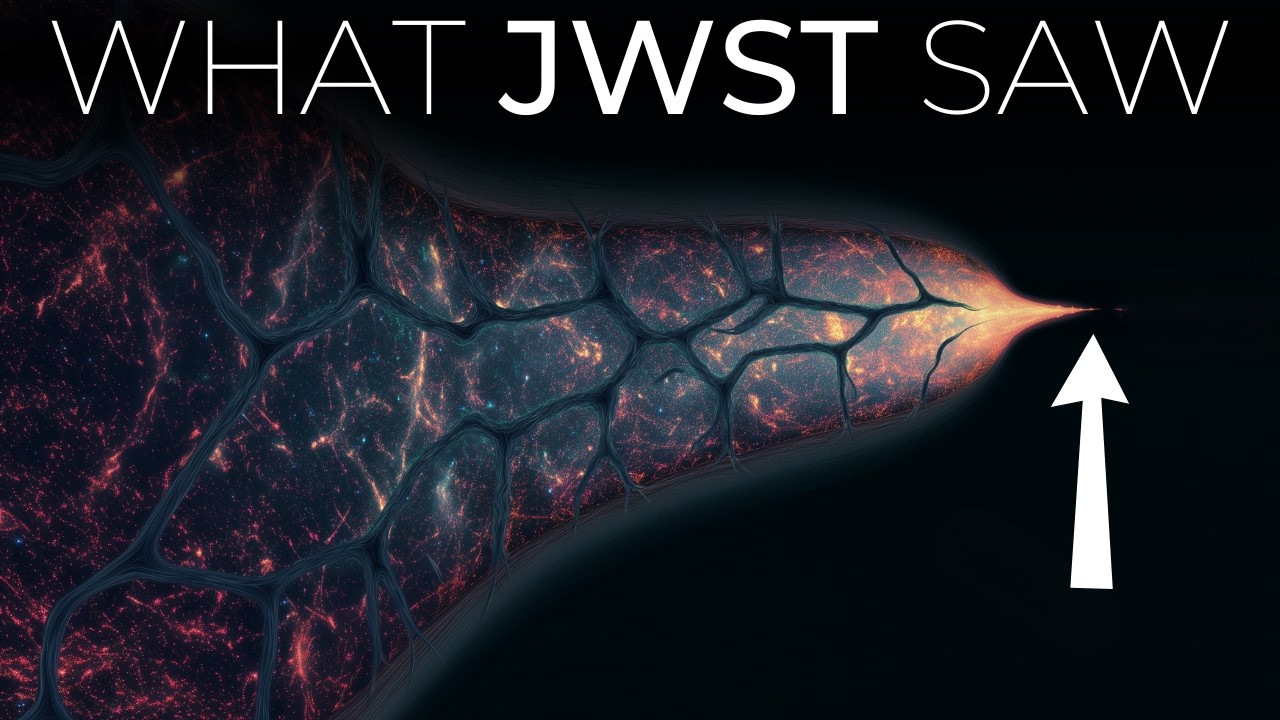
Astronomers using the James Webb Space Telescope (JWST) have identified a population of “mysterious red dots” in the early universe. Unlike typical young, blue, and irregular galaxies, these objects appear compact, sharply defined, and exceptionally red.
First identified during the Cosmic Evolution Early Release Science (CEERS) survey, these points of light suggest the existence of unexpectedly massive galaxies dating to as early as 600 million years after the Big Bang, challenging existing models of galaxy formation and evolution.
▀▀▀▀▀▀
Timestamps:
0:00 James Webb
1:45 What We Were Supposed to See
4:33 The Discovery
11:00 The First Theory That Broke
16:02 The Second Theory That Broke
20:18 Enter the Black Hole Star
26:15 The Other Ideas Still in Play
▀▀▀▀▀▀
Subscribe to Our Doc Channel
https://www.youtube.com/@UCpFYKH_eSPdKsuXdlVMI9xQ


@ajce_sk113
August 8, 2026 at 9:34 am
Due to what the hairy ball theorem says the hydrogen that makes the envelope of the black hole stars would colide frequently because of its speed and the little red dots would become regular pulsars very soon so best we could do is measure its life span
@Liminary-Dev
August 8, 2026 at 9:34 am
It looks like the end stage of a galaxy, we all know supermassive black holes are in the center of the Milky Way, so this gas around these dots seem to be the stage of a galaxy where all the planets and stars have been consumed by the black hole and only thick dust of clouds remain. If super massive black holes are eating what's in a galaxy by pulling in the material around itself making it spin, then it stands to reason that there has to be galaxies that have been completely eaten by their black hole.
@vesku892
August 8, 2026 at 9:34 am
Actually interesting subject, the AI narrator just pisses me off enough that I will skip this
@s9josh778
August 8, 2026 at 9:34 am
You can't really say the "high density" is a problem. It's what you expect when when space, time, and physics itself is in a pre-expanded state.
@doublesam6514
August 8, 2026 at 9:34 am
OH MY GOD THIS IS THE BLACK HOLE SUN NO FUCKIN WAY
@wesleycurryii3341
August 8, 2026 at 9:34 am
1. SPACE is infinite in size. In every direction you point your finger to in space, it goes FOREVER WITHOUT END. 2. JESUS created it. There was NEVER anything you call the big bang.
@CaliApexDrifter
August 8, 2026 at 9:34 am
I cant sit and listen to this AI voice reading a AI generated script
@johnnyveng4014
August 8, 2026 at 9:34 am
They just can't believe that a super-mind made this place.
@Thomas-f7x
August 8, 2026 at 9:34 am
Nice ai script
@kelvinle8662
August 8, 2026 at 9:34 am
Black hole stars can't be the answer. I literally thought it up halfway into the video.
@colewest7096
August 8, 2026 at 9:34 am
So, my initial thought at minute 22, is that they are white holes, the theoretical opposite of a black hole.
It explained the brightness, the rapidly moving away gas, and the general size. At least it explained it to me.
Still watching, though, to see what they found out.
Edit: So, no one is thinking white holes. Dang. I was hoping it might be an option.
@eugenecook2234
August 8, 2026 at 9:34 am
Perhaps these are remnants of the formation our universe within a black hole? Singularities abound, when you look. The chances that we exist are, oh so, minuscule, yet we do. I believe this is a glimpse at that splitting where our parallel universes divide, perhaps.
@Surgeplex
August 8, 2026 at 9:34 am
Maybe it's a center of a galaxy that has eaten all its stars? Since they are so small it would make sense it could be what the end of a galaxy looks like
@iamkerchooo
August 8, 2026 at 9:34 am
Does this guy not cite any sources? I wanna watch his stuff but I'm really skeptical.
@aeoliashenberg9678
August 8, 2026 at 9:34 am
Maybe like, red holes, galaxies fully consumed by a black hole surrounded by the ejected mass constantly being consumed and ejected
@AidanSomerville
August 8, 2026 at 9:34 am
The nothing/everything divided itself and we are living in between.
@SteamingLumps
August 8, 2026 at 9:34 am
your AI script fucked you where you said bonfire burners around the 3-4 minute mark. i think what you meant to say was maybe bunsen burner
@abbadon-and-on
August 8, 2026 at 9:34 am
What if the universe had no beginning and will never end? It's hard to imagine, even harder than contemplating infinity ♾️
@mantarlos
August 8, 2026 at 9:34 am
please stop using AI in the script
@andrewrickard
August 8, 2026 at 9:34 am
Or…are they refracted images of the entire early universe? Or…are they other whole universes?
@mike-d9g6z
August 8, 2026 at 9:34 am
These are super stars that defy the early laws of physics and are transforming into black holes by sheer mass
@hille103
August 8, 2026 at 9:34 am
So…. super certain and confident scientists were wrong? I’m shocked.
@ArcticLost
August 8, 2026 at 9:34 am
Listening to this much ai gives me a headache
@BillHillard
August 8, 2026 at 9:34 am
OMG! You people are just ignorant. CLEARLY god got behind on things and he forgot to take down his Christmas lights! It happens to deities too, you know. You fall asleep on the couch after a few pints and next thing you know the kids are grown and pointing deep space telescopes at your junk!
@sangriabiscus2856
August 8, 2026 at 9:34 am
Data does not match theory. Distort, discount, ignore, change, force data to match Big Bang bust theory.
@Walter_
August 8, 2026 at 9:34 am
We're basically all playing a videogame with no source code available and no debugging/memory viewers.
The only way we can measure and interpret things is by building machines in the game.
But naturally, everything is contained inside the game, unless you find an exploit to escape, but so far nobody found something like that yet.
Also there is always the question of: "How did {x} come to be?"
and any explanation gets hit with the same question again
@ProfessorOfCookies
August 8, 2026 at 9:34 am
So dark forest theory is correct and we can see the damage advanced weapons did to other galaxies xX
@JimmyPorter-i8u3z
August 8, 2026 at 9:34 am
Clearly, those are the simulation pixels
@Zahadume
August 8, 2026 at 9:34 am
Im glad that they came up with an explanation besides of'It must be dark matter doing dark matter things.' Dark matter is such a BS excuse.
@lisaoglesby9237
August 8, 2026 at 9:34 am
Collection of souls
@nickolasredbear132
August 8, 2026 at 9:34 am
Maybe the red dots are anti matter galaxies
@Skreedence
August 8, 2026 at 9:34 am
Do they though?
@gelidia
August 8, 2026 at 9:34 am
Just saw another physics content creator talk about how stars that become black holes may actually be rebounding extremely slowly in our time frame (within the event horizon, it continues collapsing down to planck length from its timeframe), and he mentioned that we would just barely be seeing the first, oldest black hole rebounding— putting 2 and 2 together, could these be rebounded star-derived black holes?
@AdmittedEnd
August 8, 2026 at 9:34 am
The universe is so bizarre, cool and scary!
@marke7898
August 8, 2026 at 9:34 am
We are all in a simulation….. enjoy the ride 🚀
@LE0NSKA
August 8, 2026 at 9:34 am
i wanna guess something crazy. they're black holes that filled up haha. and now it's just blasting out stuff (gas)
@JameyEddy
August 8, 2026 at 9:34 am
So… they explain the red shift, then say they were expecting to see blue light, but it's red shifted, so it's exactly what they expected — blue light red shifted across the spectrum as it traveled space…
@barnardclifton5516
August 8, 2026 at 9:34 am
First time in years I've seen anyone mention Eddington's limit. Noice! lol my favorite part of physics. Chaos after order. Gotta love the cosmos!
@zeta4687
August 8, 2026 at 9:34 am
it's good to find something that is not included in current physics, which means the theory has more chances to get better. better than trying to get new theory out of existing evidence
Comments are closed.