
What If We Nuked Mars?
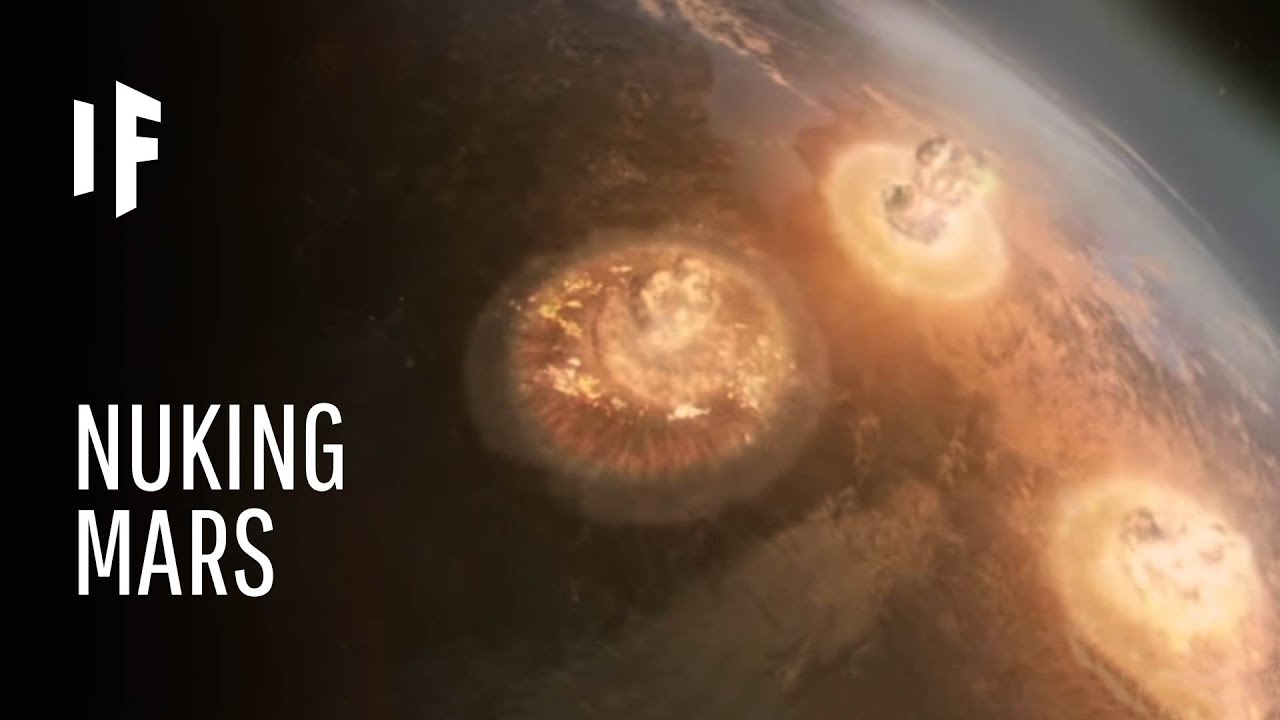
Elon Musk wants to nuke Mars. What are the consequences? Without nukes, life on Mars might be like this: You’d live in giant glass domes, and grow small portions of food inside. And if you happen to go outside, it would be in your big clunky spacesuit, and you wouldn’t be able to stay out for long. But it doesn’t have to be like this. But Mars could end up looking and feeling a lot more like your planet, Earth. But how? Well…
Transcript and sources: https://insh.world/science/what-if-we-nuked-mars/
Watch more what-if scenarios:
Planet Earth: https://www.youtube.com/watch?v=_-HhCwYD7rc&list=PLZdXRHYAVxTJCzxwmCq0NNpYq9N9wyb2l
The Cosmos: https://www.youtube.com/watch?v=gfuJyVkMH_g&list=PLZdXRHYAVxTJno6oFF9nLGuwXNGYHmE8U
Technology: https://www.youtube.com/watch?v=CS3bBO05fpU&list=PLZdXRHYAVxTIeRY3JtgXgoGqSEB7kDdKO
Your Body: https://www.youtube.com/watch?v=QmXR46TrbA8&list=PLZdXRHYAVxTJNsV9FFeNAKl2ySsHj8GZO
Humanity: https://www.youtube.com/watch?v=fdCDQIyXGnw&list=PLZdXRHYAVxTIFnvmOeWbv-Mt8zFxSCSvZ
Follow what-if on Instagram for bonus material: https://www.instagram.com/whatif.show/
Suggest an episode: http://bit.ly/suggest-whatif
T-shirts and merch: http://bit.ly/whatifshop
Facebook Watch: https://www.facebook.com/What.If.science
Watch on Tubi: http://bit.ly/what-if-tubi
“Imagination will often carry us to worlds that never were. But without it, we go nowhere.” — Carl Sagan
Produced by Underknown in Toronto, What If is a mini-documentary web series that takes you on an epic journey through hypothetical worlds and possibilities. Join us on an imaginary adventure — grounded in scientific theory — through time, space and chance, as we ask what if some of the most fundamental aspects of our existence were different.
#ElonMusk
Feedback, inquiries and suggestions: https://underknown.com/contact
Comments
Latest news


@IRLlore4U
January 24, 2026 at 4:39 am
I think we could do it
@H0m0_5apiens
January 24, 2026 at 4:39 am
A lack of a magnetic field lets the solar wind directly bombard a planet's atmosphere, stripping it away through processes like sputtering (particles knocking atoms loose) and ion pickup (charged particles getting swept away), leading to significant, long-term atmospheric loss, as seen on Mars, because the magnetic field normally deflects these harmful charged particles. Earth's magnetic shield (magnetosphere) prevents this constant erosion, protecting our atmosphere and oceans.
How it works:
Solar Wind Interaction: A star, like our Sun, constantly emits a stream of charged particles (solar wind). Earth's magnetosphere acts like a shield, diverting most of this wind.
Direct Collision: Without this shield (like on Mars), the solar wind slams directly into the upper atmosphere. Sputtering: The high-energy solar wind particles collide with atmospheric gases (like CO2, nitrogen, oxygen), knocking them away into space, a process called sputtering.
Ionization & Pickup: Solar wind particles can also ionize atmospheric gases, turning them into charged ions. These ions are then caught by the solar wind's magnetic field and dragged away from the planet.
Atmospheric Erosion: Over billions of years, this continuous stripping process removes significant amounts of atmospheric mass, making it difficult for water to remain liquid on the surface, as seen on Mars.
Key Example: Mars Mars lost its global magnetic field as its core cooled.This allowed the solar wind to strip away most of its atmosphere, transforming it from a potentially wet world into the cold, thin-atmosphered planet it is today.
My point: mars will not be able to hold on to a significant atmosphere due to a lack of magnetic field.
@zakglove6536
January 24, 2026 at 4:39 am
What are we waiting for? We should just use hydrogen bombs and oxygen bombs 'yet to be invented. "
@Cinehotties
January 24, 2026 at 4:39 am
Wasn’t this an episode of Doctor Who
@Allstar_bacons
January 24, 2026 at 4:39 am
Mars just seen so many suns
@notyoutube8128
January 24, 2026 at 4:39 am
Wouldn't work anyway. Mars's magnetic field is non-existence. The amsphere will keep getting blow away by the sun
@fernandez9765
January 24, 2026 at 4:39 am
Wild, i just came up with an entirely different unheard method of how to restart it. (Maybe not)
@gandalfZamoiski
January 24, 2026 at 4:39 am
idiota robił ten materiał… same eksplozje zapaliły by wszystko co jest w okolicy.. rozgranie atmosfery i uwolnienie wody to tylko pierwsze etapy deformacji roślinność i mikroby które by wtedy się tam wytworzyły zaczęły by dopiero tworzyć nową atmosferę z biologii, geografii i fizyki to miało pałe
@Me-Only-Not-You
January 24, 2026 at 4:39 am
Mars is not an option for short term Human survival. Deal with it.
@thomasbooth3120
January 24, 2026 at 4:39 am
If god made a atmosphere on planet earth how did he do it and from where and what kind of let's say missiles did he use and from where? To
kick start the atmosphere
@sbcburgos2300
January 24, 2026 at 4:39 am
This is idiotic….nuking Mars would make it radioactive and even more hazardous to life than it is now. Way to go Elon Musk, with your fake science!
@Stor_mify
January 24, 2026 at 4:39 am
“It would take decades”
Rn we’re low-key already cooked cuz of global warming so better go at it
@TommyHawkins-l5l
January 24, 2026 at 4:39 am
I want to know why we haven't
@stefanthorpenberg887
January 24, 2026 at 4:39 am
If we check the size of Mars, and then the mass of it, it becomes clear that it’s not so dense. If you blow up a less stable unit, there’s a risk it breaks into pieces. Some of those can rain down on earth. It will be the end of humanity.
@Limemonke107
January 24, 2026 at 4:39 am
You just can't shot a hole into mars–doctor Samuel haden
@troysimmons506
January 24, 2026 at 4:39 am
we need a moon rail gun and alot of ocean water along with a few nukes
@GagandeepSingh-zp5ss
January 24, 2026 at 4:39 am
The question is, how fast do we really want to live on Mars?
@itsallgoodlove830
January 24, 2026 at 4:39 am
Instead of nukes how about hydrogen bombs
@jaydenhockett9670
January 24, 2026 at 4:39 am
What if nuclear war made mars unhabitable originally
@database_enjoyer3000
January 24, 2026 at 4:39 am
what if.. we just minded our own business and not try to nuke stuff
@tokus64
January 24, 2026 at 4:39 am
Terraforming Mars so we can destroy it in 200.000 years.
@pulauTiomanIsland
January 24, 2026 at 4:39 am
Do you guys notice how terrifying is the nuclear bomb explode sounds .. when I listening to this blast sounds in real life, my soul will already left my body just only listening to this very intimidating sounds .
@majoykgothatso
January 24, 2026 at 4:39 am
Yh lets nuke it
@Adam-pu6jg
January 24, 2026 at 4:39 am
If Mars gets nuked, then you end up with a very radioactive candy bar 😂
@DavidBertucci
January 24, 2026 at 4:39 am
What if: We nuked Uranus?? 😂
@joshuabradshaw5270
January 24, 2026 at 4:39 am
This is easily the most retarded interpretation of this concept. Please stop speaking until youre finished practicing thought. 👀
@RememberingWW2
January 24, 2026 at 4:39 am
You would need to create a magnetosphere first or you would strip away the entire atmosphere that you wanted to create in the first place from the radiation of the Sun.
Comments are closed.