
Wolves carrying remains of beavers they killed
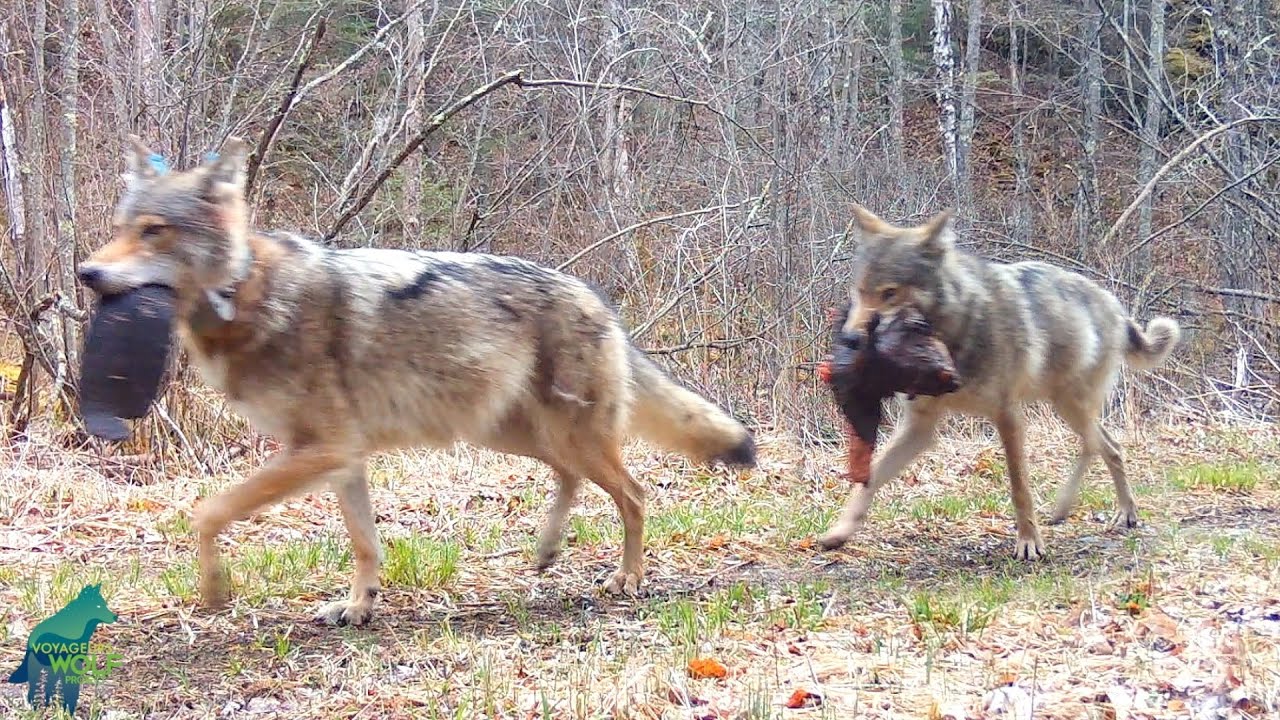
Beavers are critical prey for wolves in the Greater Voyageurs Ecosystem for a 7-8 month period of time, roughly April to October/November…i.e., when ice on lakes and ponds is largely absent.
Beavers likely constitute, on average, ~30-40% of all biomass wolves obtain from predation during this period. That said, we have studied numerous wolves for which beavers are the primary prey during the spring to fall.
For instance, beavers can constitute up to 82% of all biomass killed by some wolves during this 7-8 month stretch. In other words, some wolves rely almost exclusively on beavers during spring to fall and then deer almost exclusively during winter.
Given how often wolves are killing beavers, we naturally get footage of wolves carrying remains of beavers they have killed, often taking the carcasses back to their pups.
The reason wolves rely heavily on beavers is almost certainly due to the abundance of beavers in the area. Beaver densities have remained roughly around 1 beaver lodge per square kilometer (and there are ~5ish beavers per lodge) for about 40 years now.
That is a very high beaver density, and likely is similar to, if not higher than, beaver densities in other southern boreal forest ecosystems in places like Ontario, Manitoba, and Quebec.
We suspect beavers are, in part, why the Greater Voyageurs Ecosystems has sustained very high wolf densities for many years, and we are actively trying to understand how beavers drive aspects of wolf population dynamics.
Prior to our work, wolf-beaver interactions had received very little attention or research. In 2018, we wrote a peer-reviewed publication summarizing all that was known on wolf-beaver interactions up to that point. In that paper, we dubbed beavers “the forgotten prey of an iconic predator.”
Of course, biologists knew wolves in a variety of ecosystems hunted beavers to an extent but that was about it. Fortunately, we have made substantial headway in understanding this predator-prey dynamic but there is much we still don’t understand…which means there is still much to be discovered!
Learn more about the Voyageurs Wolf Project:
Website: http://www.voyageurswolfproject.org
Facebook: http://www.facebook.com/VoyageursWolfProject
Instagram: http://www.instagram.com/voyageurswolfproject/
Twitter: http://www.twitter.com/VoyaWolfProject
Threads: https://www.threads.net/@voyageurswolfproject


@peanut2872-z2b
April 14, 2026 at 3:18 pm
That's very cool. How do they catch the beavers?
@briseboy
April 14, 2026 at 3:18 pm
By the way, beavers also create dens in river banks. They do here in the far west – their prints are unmitakeable. Even close to the sea in Redwood National Park, where also unmistakeable taking of young deciduous treesand bush, such as willow are visible.
Few wolves have so far ventured across I-5 which runs through central CA and Oregon, n-s.
The largest elk species, Roosevelt Elk and mountain lions are found right into the coastal vegetated dunes there.
An "ambassador " wolf with whom i was bonded was once taken aback ( their cognitive responses are VERY clear to intimates) by the size and uniqueness of C. canadensis roosevelti spine and skeleton in that area.
The region does have really viable habitat, and it is hoped that theywill at some near time establish themselves. The SW OR and NW CA region has less persecutory humans , less roads, other than logging roads, with the only drawback being steep country for a coursing predator. Yet, far west BC to the north has the small "sea wolves" and the large wolf, who socialize , den and occupy distinct territories from one another.
(We know that Minnesota appears to have such separation of subspecies. Marais is French for marsh/swamp; i was bornin MN in a wilder time, hearing wolves very young from the forested hills by a swampy area, where they could den in safety from human guns)
@МаксимБойко-н9ц
April 14, 2026 at 3:18 pm
Волк пытается обойти фотоловушку
@miladydewinter8551
April 14, 2026 at 3:18 pm
They know the camera is there. They all look at it, some going around it to avoid it
@clausthaler2003
April 14, 2026 at 3:18 pm
Wölfe sind wunderschöne Tiere nicht umsonst wurden und werden sie von den Naturvölkern Nordamerikas verehrt.
@valeriestgildasderhuys7168
April 14, 2026 at 3:18 pm
Tous le monde a le droit de se nourrir surtout la faune
@charlessmith-vh9cw
April 14, 2026 at 3:18 pm
It is very difficult to catch and kill a beaver, unless it is trapped. I suspect the wolves took advantage of someone who didn't care ( yes, this describes trappers) if the animals they trapped were in physical and mental agony for hours and hours or days and days.
@heib8369
April 14, 2026 at 3:18 pm
سبحان الله العظيم
@drandy.myanmaryoutubechannel
April 14, 2026 at 3:18 pm
Amazing !
@obserwatorzyprzyrody
April 14, 2026 at 3:18 pm
Super filmik Pozdrawiam serdecznie
@davidpeightal4918
April 14, 2026 at 3:18 pm
These wolves have adapted to beaver hunting after they have wiped out the deer population.
@williamlocklear1283
April 14, 2026 at 3:18 pm
Almost every wolf that passed looked at the camera and seemed to be very much aware of it.
@musherstails
April 14, 2026 at 3:18 pm
Interesting to see the swinging bellies on many of the wolves. They have eaten the other half. Also interesting to note that they carry the tail/hind quarters. The entrails, head and fore quarters are eaten first. Thanks for the video.
@JohnMacFergus-oz5cp
April 14, 2026 at 3:18 pm
Darn, did they dig into the lodge? Must have taken a while. Curious. Mother nature shows no favorites. TKS for the post.❤
@lyndacarter4586
April 14, 2026 at 3:18 pm
Pickin’ them off like flies 😳
@FluffyMurderMachine
April 14, 2026 at 3:18 pm
What is "62 D" on the post in the last shot?
@genghisville5044
April 14, 2026 at 3:18 pm
Gotta keep the pups fed.
@wtwb-c6e
April 14, 2026 at 3:18 pm
They look so happy to get food 😊
@martinyuhas929
April 14, 2026 at 3:18 pm
They are very aware of these trail cameras.
@MissyMuthaTruckiN
April 14, 2026 at 3:18 pm
💞 Please protect all wolves from hunters
@robertmclean9737
April 14, 2026 at 3:18 pm
Wolves feed their pups by regurgitating what they ate, never carry mest back to the den,!
@carriemainquist757
April 14, 2026 at 3:18 pm
The cycle of life.
@Pecanut
April 14, 2026 at 3:18 pm
😢
@lan1331
April 14, 2026 at 3:18 pm
Love Beaver Tails. My favourite is Killaloe Sunrise. 😉
@joanmcfadyen
April 14, 2026 at 3:18 pm
Very good description with today’s video.