
How Additive Synthesis Works
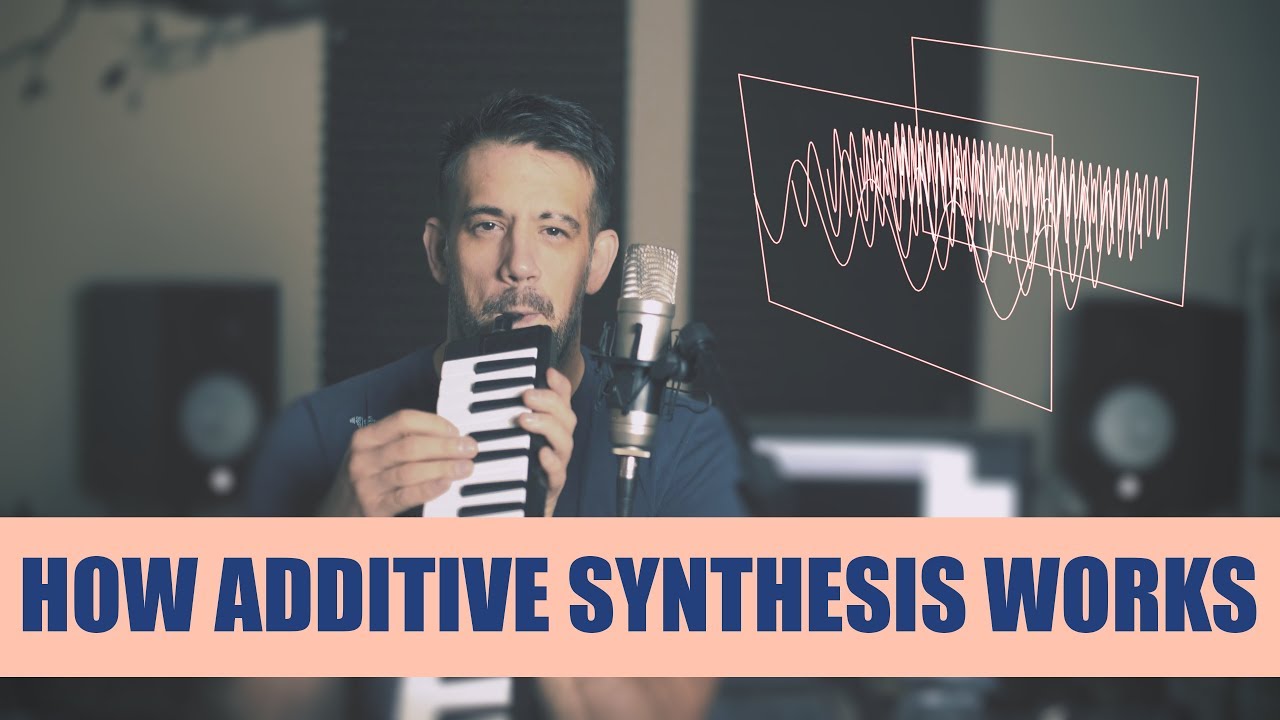
Let’s clone an instrument’s timbre using nothing but sine waves and mathematics on our first plunge into the deep, powerful world of additive synthesis.
Let’s clone an instrument’s timbre using nothing but sine waves and mathematics on our first plunge into the deep, powerful world of additive synthesis.


@lennon.hiphop
April 18, 2026 at 12:54 am
Given the popularity of your political videos, it may be time to update your channel description.
@lennon.hiphop
April 18, 2026 at 12:54 am
This is the “natural flavors” version of music
@bennethos
April 18, 2026 at 12:54 am
very cool, I wonder if 8y later there are easier ways to do this now with serum2, vital or pigments ?
@ポールの赤テレ
April 18, 2026 at 12:54 am
"The elon musk of guitar center".. could you see that? Guitars that explode, keyboards that fly off the stand and into walls, floor staff doing hitler salutes… that'd suck pretty bad.
@Animo1681
April 18, 2026 at 12:54 am
"I' don't want to try being the elon musk of guitar-center" hits different 7 years later
@JCProductions58
April 18, 2026 at 12:54 am
GOSPEL
All of us are evil and deserve to go to hell
If you have lied once, stolen a small thing, taken the lords name in vain(OMG), looked at someone sexually, you are worthy of going to hell! Here is the good news Jesus Christ paid the fine by dying on the cross so that all we have to do to get to heaven is confess plus turn away from our sins and to put all of our trust in Jesus Christ alone for your salvation!
@sammaddison2085
April 18, 2026 at 12:54 am
7 years ago when this video came out I wanted to know how to do that cello thing so bad. Just re watching the video hoping theres some behind the scenes of the album or someones figured it out by now.
@gmouchta
April 18, 2026 at 12:54 am
How did you approach creating the Cello sound ? is it taking a real sample then throwing into the analyzer and then try immitate the frequency series ? i am only using Logic pro and i am not aware of tools that could give me the result you achieve with audition
@JINX_ZIRS
April 18, 2026 at 12:54 am
This is incredible, I’ve been theorizing this in my head for two years now. Thanks for the deep science and mathematics applications to audio engineering as a whole.
@oscarrivas7240
April 18, 2026 at 12:54 am
They said the same thing about digital synths in the 80’s, yet here we are in 2025, still paying $5k for analog synths
@maxwarfield6699
April 18, 2026 at 12:54 am
?!
@davidscanlan
April 18, 2026 at 12:54 am
"Or is it" I fully expected the V Sauce theme to kick in
@Lantertronics
April 18, 2026 at 12:54 am
I love the phrase "Elon Musk of Guitar Center" 😉
@KordTaylor
April 18, 2026 at 12:54 am
Me thinks you should use max msp. You are that type. 😂
@KordTaylor
April 18, 2026 at 12:54 am
Ghetto saw 😂
@monteschwarzwalder7155
April 18, 2026 at 12:54 am
It's another option
@izzygramp7525
April 18, 2026 at 12:54 am
I really wish you were correct in being confident about the future, 6 years onwards… I'm still looking for a harmor equivalent that does resynthesis that's not daw locked ;__;
@innapinch7112
April 18, 2026 at 12:54 am
I work in Linux, and recently I've gotten obsessed with experimenting with the additive synth "Organic", which is an eight channel additive synth in LMMS. I feel like, like everything else, this is taking me down a road.
@LeFnob
April 18, 2026 at 12:54 am
How did you build that cello at the end there?
@Andronicus2007
April 18, 2026 at 12:54 am
The Kawai K5000 was a hardware synth released in 1996. It could do a lot of similar stuff to what is demonstrated here. I have a Cello patch similar in terms of realism, will get around to sharing my patch soon to other K5000 owners.
@joyboricua3721
April 18, 2026 at 12:54 am
I'd like to thank all those mathematicians & engineers whose insight have vested on us a way to understand how systems work.
Moreover, all these transforms are all related… Even on quantum mechanics!
And Ben, you've done an outstanding job. Thank you.
@AmaroqStarwind
April 18, 2026 at 12:54 am
Additive, Subtractive and FM Synthesis… what about Ring Modulation?
@KordTaylor
April 18, 2026 at 12:54 am
I never realized that you liked analysis/resynthesis. Me too! But man you are so great at explaining and doing the math and all. 😍
@Pspiralifemusicandedu
April 18, 2026 at 12:54 am
super keen but cant find that follow up additive synthesis video on your channel….
@issiewizzie
April 18, 2026 at 12:54 am
wow you can see the future
@Pyroific
April 18, 2026 at 12:54 am
that cello transforming between the realistic sound into the various synths and back again was sooo cool!
@theRiver_joan
April 18, 2026 at 12:54 am
I dropped out less than a year before I could finish my math degree so I’m glad I have practical use for Fourier analysis now.
@daneguitarist1
April 18, 2026 at 12:54 am
I love jamiroquai! nice! my third album i ever bought was the album with virtual insanity on it…. i believe it is called Supersonic?
been a fan every since and love all their other stuff
@andrekuz
April 18, 2026 at 12:54 am
When describing the basics of additive synthesis, it sounds just like using draw bars on a Hammond organ! And your first example of doing a few harmonics sounded just like a B3. But, because the Hammond used physical sine wave generators (tone wheels), it could only be built with just under 100 of them, and their frequencies are tempered, such that the harmonics are shared across every note, blending across all notes played, and especially blended when pulling all the bars out. Then it becomes pretty hard to achieve dissonance and instead there’s a smoothed out harmony of every note played to each other. Great for rock and roll players to just go wild, never a false note, but of course never a true one either (hence cheesiness). I don’t think samplers capture this effect, and I wonder if there are true circuit emulators that do (I don’t follow modern gear enough to know). But your mathematical breakdown of the unique harmonic series frequencies for every note one would need to reproduce things accurately is a nice clarification of how challenging this kind of tech would have been to consider in the time of early electronic and electro-mechanical organs!
@redeveredev
April 18, 2026 at 12:54 am
hopefully you'll see this, was that final sound achieved in either Alchemy, Csound, or Kyma? they are the only two systems I could understand such a sound being made in… harmor and morphine dont seem like they could do such a smooth "randomisation" of the partials.
@RyanMoodyMusic
April 18, 2026 at 12:54 am
You are a total G
@BrunoDeLimaS
April 18, 2026 at 12:54 am
Even though synthesizing could require less space in disk since it only require parameters for the sound, the process of synthesizing is heavy for processors, that is why some digital/computer synthesizers usually create a temporary library with all the notes/pitches. Like a pre synthesis of the sound, so it reduce amount required process for rendering and live play.
Nice vídeo, thanks for sharing!
@johnmccartney3819
April 18, 2026 at 12:54 am
There's a new VST synth that builds it's sounds using nothing but sine waves, and a lot of clever modulation. Sines, lovely!
@redblock1382
April 18, 2026 at 12:54 am
Bro i just bought a cello wtf are you doing
@jamesforrest9837
April 18, 2026 at 12:54 am
i love the 3d graphics! great production value
@AntonKuznetsovMusic
April 18, 2026 at 12:54 am
11:40 great track
@eli-shulga
April 18, 2026 at 12:54 am
Watch that couple days ago and really helped me understanding additive synths!
But now, after letting things fall into place (in my brain)
Got confused about what you said in the last part
about additive can solve huge files sample issue by emulating same sounds.
But if you emulate each frequency of the original sound
and going to the same resolution of partials as the sample (lets say 44100)
than the amount of data needed to be stored is basically the same as the sample?
Or you will use less partials but then its basically the sample at a lower rate (quality)
only you chose where to "cut"
This still does not sits well with my understanding
PS: I mite meshed a bunch of things, still new to all of this 🙂
Thanks
@EvilDragon666
April 18, 2026 at 12:54 am
My thoughts are – additive synthesis is definitely a useful tool, but it is never going to make samples obsolete. Just IMO! You need a ridiculous amount of processing power to handle enough partials (and allow good enough polyphony!) to completely fool us. To emulate a static sound is not that difficult and I mean you can do it in Alchemy (700 partials max). But the big kicker is emulating the actual physics and behavior of a particular instrument (which is easier done with physical modeling than additive synthesis), THAT would take an awful lot of time to get right for each instrument. It took Pianoteq 10 years to get to an acceptable level of quality (and that's not an additive synth – so for additive synth it would be even more difficult/time intensive!). And what about the recording chain? The mic, the room? Samples still portray this most faithfully, and you cannot reproduce this with 1000 partials. Maybe 10000 would suffice.
And ultimately: sampling is SIMPLE to use. Additive synthesis is anything but. Yeah you can get to places with machine learning, but that is still not really layman people territory (programming such algorithms), while anyone can grab a mic and a recorder and… do stuff with it.
I say all this as a supporter of physical modeling (I absolutely adore Pianoteq), but also with deep knowledge about sampling (since I've been developing Kontakt libraries for the past 13 years).
@Geopholus
April 18, 2026 at 12:54 am
Additive synthesis is also the past of Synthesis. When You made Your dull saw You made a mistake, it was instead a "sharp" saw because You neglected to reduce each successive higher harmonic amplitude by 1 over it's frequency.
@morpheon_xyz
April 18, 2026 at 12:54 am
Fascinating video, definitely subbed, and at this point in time, I'm seeking it video content like these to really become better at sound design, and understanding how to make anything from basically nothing 🤔👀 thanks for this video tho, learned a lot
@thetruthexperiment
April 18, 2026 at 12:54 am
You need to up the contrast. Are you shooting raw with a black magic camera? Yeah you gotta make the blacks black bro.
@thetruthexperiment
April 18, 2026 at 12:54 am
Could you have a synth with all these capabilities? Do they make one that isn’t a giant modular?
@pierbover
April 18, 2026 at 12:54 am
You should make a video on how you made that cello!
@kaancfidan
April 18, 2026 at 12:54 am
When you mention that additive synthesis can be used where disk or memory resources are limited (like games on microprocessors etc.), it sounds like you are reinventing lossy compression (like MPEG/Audio).