
Coast Guardsman’s enduring memory of the Edmund Fitzgerald’s final voyage
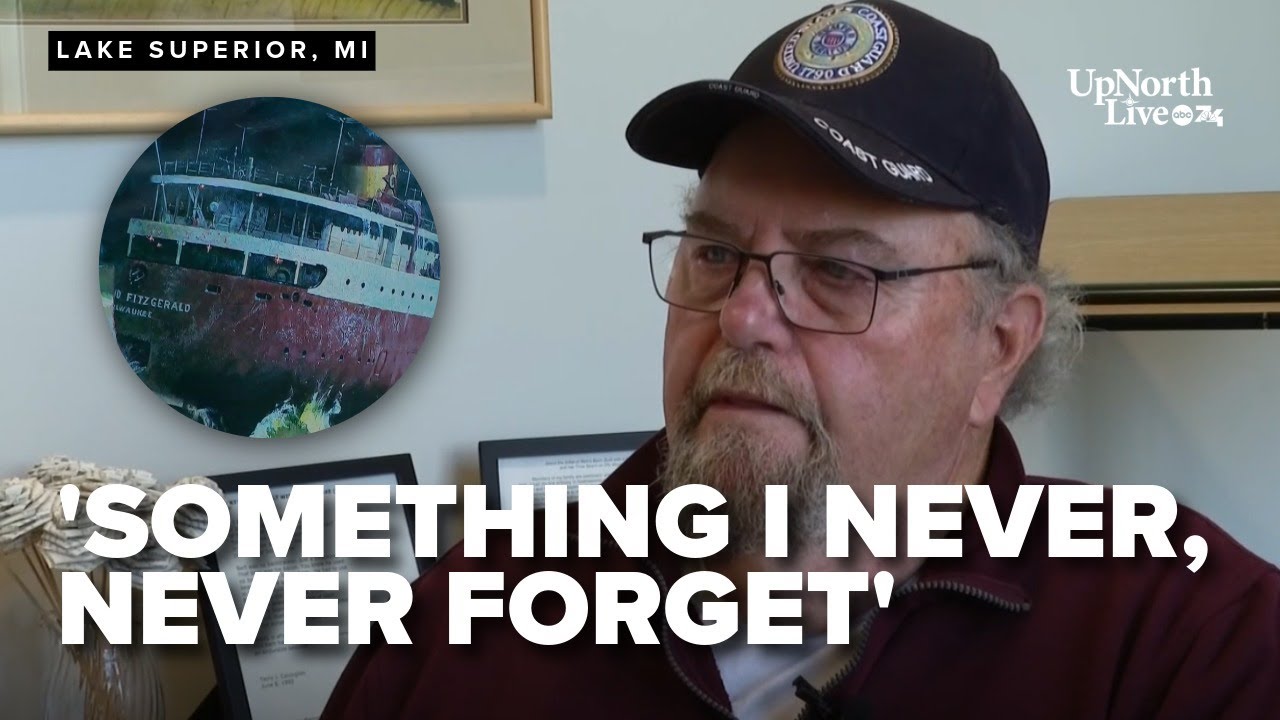
Monday marks the 50th anniversary of the sinking of the Edmund Fitzgerald, a tragedy that still resonates deeply with those who witnessed the events unfold.
Among them is Michael Padisak, who, at 19, was stationed with the Coast Guard on a small rock in Lake Superior the night the Fitzgerald disappeared.
“Well, when we graduated from our technical school, they put all of our names up on a board. And you could pick from those whichever one you wanted based on your ranking in the class and so that was left and I picked Rock of Ages light station,” said Padisak.
Padisak recalls his time at the Rock of Ages light station, a lighthouse built in 1907 on a tiny piece of land off the southern end of Isle Royale National Park.
“It’s actually off the southern end of Isle Royale National Park about I think it’s about five or eight miles or something like that. It’s basically just a rock sticking out of the water with a lighthouse built on it. It was built in 1907,” he said.
He and two other Coast Guardsmen spent 28 days at a time ensuring the safety of passing freighters.
“If you could imagine taking a spark plug and screwing it into a piece of rock sticking out, that’s kind of what it looks like,” said Padisak.
Padisak and two other Coast Guardsmen would spend 28 days at a time there making sure the passing freighters knew where to go and where not to.
“We had a fog horn we’d have to turn on when the visibility got so low. Of course, turn the light on every night and every afternoon whenever,” Padisak said.
And the lighthouse sent out a radio signal that vessels could use to triangulate their position to keep them on route.
“Yeah, they would be kind of off in the distance. We’d see them going by probably 10, 15 miles away or maybe more, I don’t know. But that was one of their routes when they would take the more northern route across the top of Lake Superior,” said Padisak.
A couple of months into his service on the rock, in early November 1975, the weather started to turn.
“That day was kind of a culmination of a weather system that had been developing for some time. The wind started blowing maybe a day or two before that, as I remember. The waves just kept getting bigger and bigger and bigger. Then of course that night, it really started blowing,” Padisak said.
The winds kept pushing the water higher and higher, the waves rising and the concerns for the mariners they knew were out in it.
“So the waves at our lighthouse were probably maybe 25 feet at the most. But further down they got bigger, I think, 30 or more down by where the Fitzgerald sunk,” Padisak said.
In early November 1975, a severe weather system developed, bringing fierce winds and towering waves.
“It just roared all the time. We would send our weather end to Duluth every two hours and give them wind speed and wave height direction and things like that. I remember going down and watching the wind speed indicator and it was setting right on 50 knots. Then it would gust up to 70 and then back to 50 knots. So, it was just like whatever a knot is, 1.2 miles per hour. So, on top of that 80 mile an hour winds or something,” Padisak said.
As the storm intensified, Padisak listened to the radio traffic between freighters.
“I could hear the freighters talking back and forth on the radio,” he said. “I knew things were getting pretty bad put there as far as the wave heights and the storm was going. I was pretty glad I was on a lighthouse and not on one of those boats.”
The situation turned dire when a ship trailing the Fitzgerald reported losing sight of its lights.
The captains of those boats, radioing what they were seeing out there until one of them reporting what he couldn’t anymore.
“The ship that was behind them called in and said, ‘I had his lights in sight, but I don’t see him anymore’ and so then they called out an emergency message and said, Any vessels in the area, please render assistance if possible or whatever and so that was the start of the whole thing right there,” Padisak said.
The Fitzgerald seemingly vanishing.
“Yeah, it just happened that fast. It was like they were talking about things, and all of a sudden it was gone. I was like, ‘what happened?’,” Padisak said.
Equally fast, the call for help coming across the radio.
Despite calls for assistance, no vessels were close enough to help, and the storm prevented aircraft from launching.
——————————–
For all of your news, weather and sports needs: http://www.upnorthlive.com
Like us on Facebook: http://www.facebook.com/UpNorthLive
Follow us on twitter: @upnorthlive.com
Download our app, available for iPhone and Android!
#traversecity #localnews #news #video #upnorthlive #michigan


@kathygriffin9465
January 23, 2026 at 11:08 am
Thank you for your service. And thank you for speaking out about the Fitz, and more.
@CherylPerry-st7xo
January 23, 2026 at 11:08 am
The companies should of pulled them ships off the waters, they knew a bad weather storm was headed their way, greed is what drove the companies before safety of the crewman. The shipping season should end in October, not November.
@Lancemillerwy
January 23, 2026 at 11:08 am
Semper Paratus
@Les_Izmor
January 23, 2026 at 11:08 am
@ 19 yo, I served on the Great Lakes icebreaker USCGC Mackinaw (WAGB-83) & later on Arctic icebreakers to Greenland & Alaska.
Great Lakes waves are shorter in length, less "rolling" & more treacherous than ocean waves.
50 kt. wind & 30' waves on the Great Lakes is terrifying to even Think about.
🫡 Semper Paratus, Mr. Padisak!
@davidclark8855
January 23, 2026 at 11:08 am
Thank you for your service. We're from waaay over here in CT.
@LinseyBurt-hc4cu
January 23, 2026 at 11:08 am
He sounds like Jimmy Stewart.
@SoberNomad
January 23, 2026 at 11:08 am
It will always seem weird to me that the Coast Guard did not send any vessels out to search for survivors, but rather asked other vessels to do so. The Arthur Anderson made port in the same terrible storm, then went back out to search while the Coast Guard stayed behind.
@DougGrinbergs
January 23, 2026 at 11:08 am
0:46 Rock of Ages light station duty
@IndyZatoichi
January 23, 2026 at 11:08 am
Gosh!
@KarriMarsh
January 23, 2026 at 11:08 am
Ship
@brendabuiskool8398
January 23, 2026 at 11:08 am
Anderson an William Clay Ford were sent outfor survivors.
@Skiddledaddle1023
January 23, 2026 at 11:08 am
The bell from the fits will always ring on every year
@JohnKotredes
January 23, 2026 at 11:08 am
Thank you sir, for your service and your recollections. I'm sure it is hard to voice your emotions!
@JohnKotredes
January 23, 2026 at 11:08 am
Thank you sir, for your service and your recollections. I'm sure it is hard to voice your emotions!
@18winsagin
January 23, 2026 at 11:08 am
Thank you for your service sir and thank you for sharing your story. It had to be traumatic for a young guy your age then.
@lonewolf9390
January 23, 2026 at 11:08 am
"Missing Edmund Fitzgerald in your area. Request you search an area 15 miles due west of Copper Mine Point , Ontario, and 15 miles north of Crisp Point, over.' – Coast Guard's general call to all vessels on the night of November 10th 1975
@lonewolf9390
January 23, 2026 at 11:08 am
I was listening to a recording of the radio traffic from November 10th 1975 between the Arthur M. Anderson and the Coast Guard not too long ago. At one point in the conversation, the Coast Guard had asked Captain Bernie Cooper if it the weather was calming down at all and he responded "Here in the bay it is, but I heard a couple of the salties talking up there, and they were wishing they hadn't gone out.' That tells you how bad it was if salt water vessels were wishing they'd never left port that night.
@True-s5u
January 23, 2026 at 11:08 am
Thank you for your service Mr.Padisak!
@dmbdmb3828
January 23, 2026 at 11:08 am
⚓️
@filmtvbiz
January 23, 2026 at 11:08 am
Thank you for your service.
You do what you do — because it’s the only thing to do.
The right thing.
The true thing.
The necessary thing.
Semper Paratus.
Godspeed.
🫡🕊️♾️
Comments are closed.