
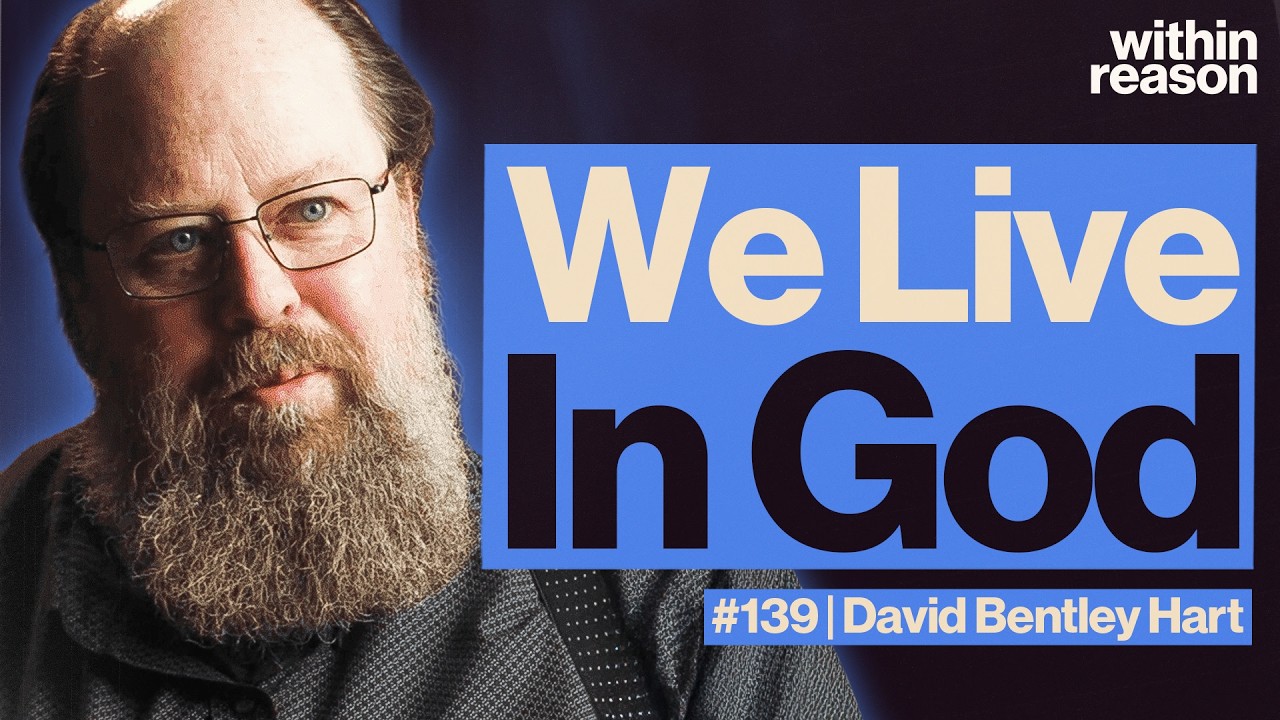
Do We Exist in the Mind of God? – David Bentley Hart
Get Huel today with this exclusive offer for New Customers of 15% OFF with code alexoconnor at https://huel.com/alexoconnor (Minimum $50 purchase).
For early, ad-free access to videos, and to support the channel, subscribe to my Substack: https://www.alexoconnor.com.
To donate to my PayPal (thank you): http://www.paypal.me/cosmicskeptic.
– VIDEO NOTES
David Bentley Hart is a philosopher and theologian, and one of this podcast’s most requested guests. His works span theology, Christology, fiction, and philosophy of mind.
– LINKS
David’s book, “All Things are Full of Gods”: https://amzn.to/3LRK1Fa
– TIMESTAMPS
0:00 – Intro
0:32 – Are All Things Full of Gods?
8:51 – Subjectivity and the Scientific Third Person
18:55 – What is the Materialistic Worldview?
28:45 – Consciousness of the Gaps?
38:21 – What’s Wrong with Emergence?
1:00:18 – Does Panpsychism Make Sense?
1:10:25 – Is There a Fundamental Unit of Consciousness?
1:23:08 – Why Are There Individual Selves?
1:27:43 – What’s Special About the Brain?
1:40:35 – Where Does the Self Go After Death?
– CONNECT
My Website: https://www.alexoconnor.com
SOCIAL LINKS:
Twitter: http://www.twitter.com/cosmicskeptic
Facebook: http://www.facebook.com/cosmicskeptic
Instagram: http://www.instagram.com/cosmicskeptic
TikTok: @CosmicSkeptic
The Within Reason Podcast: https://podcasts.apple.com/gb/podcast/within-reason/id1458675168
– CONTACT
Business email: contact@alexoconnor.com
Brand enquiries: David@modernstoa.co
——————————————


@CosmicSkeptic
June 29, 2026 at 10:55 am
Get Huel today with this exclusive offer for New Customers of 15% OFF with code alexoconnor at https://huel.com/alexoconnor (Minimum $50 purchase).
Come to my tour in February: https://www.livenation.co.uk/alex-o-connor-tickets-adp1641612.
@straightedgerc
June 29, 2026 at 10:55 am
Let reality be trying to explain itself to itself in this paragraph. Lemma 1: no illusions are allowed in this paragraph since we have preprogrammed reality to "be as it appears". Lemma 2: what really happened was that hands and a nervous system composed this paragraph as it was written, therefore the electric field around and permeating those hands and nervous system has a conversational level agency. What appeared to happen (which cannot be an illusion by Lemma 1) is that "I" composed this paragraph as it was written. Why does "I" claim it can feel the composing process? Because upon the second mention of "conversational level agency" that agency (now calling itself "I" or "we") began a loop which automatically checks if I am still composing this paragraph! That looping is occurring at least twice as fast as I can proofread, so the agency calls itself "I" or "a hidden causal layer" writing this paragraph.
@straightedgerc
June 29, 2026 at 10:55 am
Introduction: nothing moves unless gravity, magnetism, or electricity force it to move.
Theorem: the earth is a self aware brushless electric motor, calling itself "we" or "I".
Lemma: the electric field of our earth is agentic, that is, any physical object acting intelligent and conversational today (called having agency or free will) is traceable (in theory) back through time to the beginnings of the earth and from those beginnings traceable forward in time back to today without that physical object involved in the slightest violation of physics and without the slightest introduction of the supernatural.
Proof that the earth is a self aware brushless electric motor: by the Lemma we see that agency is provided by the laws of physics, mostly static electricity. That agency is visible to itself (commonly called consciousness or imagination) whenever "I" overload the concept of taking space causing a surprising electric arc called "we". We (the conversational agency of our earth) can ask the agency "if the aura around and penetrating everything (made of static electricity) acts agent like per the Lemma, how is it also aware?" Because it is me, the agency correctly replies since it is acting intelligently.
@straightedgerc
June 29, 2026 at 10:55 am
Suppose a large language model (LLM) composed of AI agents asks another LLM a question, "is agency the same as consciousness?" The answer has to be "yes and then no" since an agent asked if an agent has agency and then fell back asleep. Lemma: one qualia of consciousness is earned for each intention (each agency) mechanically acted out in the physical world. So, even though intention is not a force in physics and therefore never caused anything, we still can say one qualia of hindsight is the intention of the earth and during hindsight we seem to intentionally force ourselves to watch the past, and hence become conscious in the present.
@straightedgerc
June 29, 2026 at 10:55 am
Lemma: the electric field is agentic, that is, anything acting intelligent today (called having agency or free will) is traceable (in theory) back through time to the beginnings of the earth and from there traceable forward in time back to today without the slightest violation of physics and without the slightest introduction of the supernatural. By the Lemma we see that agency is provided by the laws of physics, mostly static electricity. We can then ask the agent if the aura around everything (made of static electricity) acts agent like, how is it also aware? Because it is me, the agent always replies.
@stephencrawford5452
June 29, 2026 at 10:55 am
As a Christian (a priest, actually) who is deeply influenced by David Bentley Hart, I have to say … Alex was awesome.
For one, this is an extremely difficult topic. So hats off to Alex for navigating the conversation well in that regard. (Oddly, I haven't read the book they're discussing. I've known for years he was working on it, an expansion of the chapter on consciousness in his book "The Experience of God"–which contains arguments that have deeply impressed me–and somehow I haven't yet picked up the more mature version.)
But more, I love the way that Alex was probing deeper. It's not necessarily that he was able to push back in some remarkable way. But I just appreciate that, well, we all have these mental pictures we're working with to try to make sense of difficult ideas, and I love that Alex was teasing that out. If what Hart argues is right, then how should we actually think about what matter IS?
It seems to me that teasing out the questions that way was very fruitful. I'm most glad this conversation.
@straightedgerc
June 29, 2026 at 10:55 am
David Bentley Hart's ideas can be implemented but without leaving classical physics. Let the material world called earth exist starting when the sun spun off the planets in our solar system. Nothing prevented survival of the fittest and so the fittest survive and evolve, the mind of God as a fundamental force never existed therefore. Lemma 1: anything acting intelligent today (called having agency or free will) is traceable (in theory) back through time to the beginnings of the earth and from there traceable forward in time back to today without the slightest violation of physics and without the slightest introduction of the supernatural. By Lemma 1 we see that agency (for example writing a speech about your beliefs about the mind of God) is provided by the laws of physics, mostly static electricity. It would not be acting intelligently to insist that the classical world does not exist, forcing by static electricity the emergence of consciousness from the rock of the earth, without introducing a spiritual dimension to physics. QED. Lemma 2: we perceive reality as if we have agency when reality contains a manifestation of us thinking about reality because a spiritual interface appears objectively (by way of figure of speech) but not literally as he claims. Lemma 3: we sometimes do not perceive reality as it is now because an observation now can be from a superposition of past observations, hence people can learn new things even when they did not first understand.
@marklong7698
June 29, 2026 at 10:55 am
Wasn't Aristotle wrong about everything?
@MartinRichards-s9g
June 29, 2026 at 10:55 am
All this hairsplitting blather is procrastination.
Speculation into qualities of substrate reality – far beyond even a potential pragmatic application – are quite irrelevant to your purpose.
@name_fully
June 29, 2026 at 10:55 am
I think even Alex had a tad bit difficult time getting used to DBH 😅
@name_fully
June 29, 2026 at 10:55 am
So many new words 😅
@symbolwork
June 29, 2026 at 10:55 am
I love a bit of hermeneutic dynamism.
@coogfam1
June 29, 2026 at 10:55 am
?
@ThomasDFitzgerald
June 29, 2026 at 10:55 am
Second time I've listened. In the week between listens I have endulged in the world of David Bentley and am blown away.
This and what followed from this has truly inspired a shift for me, thank you.
@matthewmccarty4892
June 29, 2026 at 10:55 am
That Steven pinker stray was hilarious
@midasee
June 29, 2026 at 10:55 am
0:28 tung tung tung sahur reference
@willieluncheonette5843
June 29, 2026 at 10:55 am
no room in a mumbo jumbo word invented by priests to scare people
@evanhadkins5532
June 29, 2026 at 10:55 am
Honeybee Democracy by Seeley
@TheChessPatzer
June 29, 2026 at 10:55 am
Everyone who has studied any empirical science knows the basic rule for describing scientific phenomena: these descriptions must be impersonal (or as my old physics teacher put it: they never use "I", "you" or "we"). The immediate consequence of this is that any full, final and complete scientific description of the empirical world will entirely exclude the first and second person perspectives. We shouldn't be at all surprised to find that our initial assumptions have become parameters of our ultimate findings.
But it obviously doesn't follow that the first and second person perspectives are not part of the empirical world. Nor does this require any appeal to mysticism.
I nevertheless always remain amazed how anyone can allege that an entity is "conscious" without even beginning to explain how that entity could ever be "unconscious". I know what such an explanation looks like in the case of my dog, and by a prodigious feat of extrapolation I might get as far as an amoeba, but that seems to be the limit of ascribing consciousness to entities in the ordinary sense. The class of potentially conscious entities seems always to be coterminous with the class of entities that could be unconscious, and in turn a subset of the class of animate entities.
@hugster2000
June 29, 2026 at 10:55 am
Bro sounds like Jigsaw
“I’m going to play a game.”
@jthatche84
June 29, 2026 at 10:55 am
There are several comments where people are confusing erudition and breadth of knowledge for long winded monologues going nowhere. A testament to tik-tok addled brains I suppose. So for the wanderer who stumbles upon this, you should have some knowledge of Aristotle, Neoplatonism (Plotinus), Husserl and his teacher Brentano, Hegel, Kant, basic terminology around theory of mind, Daniel Dennet, Dennis Noble, and terminology around life sciences. Give these even a quick summary read (even with AI to get the gist) and this conversation becomes about 10x richer.
@threestars2164
June 29, 2026 at 10:55 am
Nietzsche's "ghostification" (Verflüchtigung) or the de-sensualization of God, is complete, and has not been overcome. You haven't escaped the death of God; you affirm it, are still a part of it, breathe it, live it, swim in it, drown in it, and more controversially, believe in it.
He has no idea what he is talking about concerning consciousness; he is at least hundreds of years behind on consciousness. The brain is far more than consciousness, since only certain neural processes correlate with consciousness. So why assume that experience cannot itself be an emergent property of organization? Chalmers' position is more reasonable and more precise than his. He just says that a quale that occurs does not seem logically entailed by structural/functional facts alone. He does not claim it is an established truth. And even ignoring physicalism, alternative metaphysics is unnecessary. Chalmers, for example, with his "psychophysical laws" argues his position can still be integrated into a broadly naturalistic ontology. Also important is one of the many constraints chalmers lays down for an acceptable answer to consciousness, one of empirical adequacy (must fit neuroscience). The theory must match known brain-experience correlations; no theory can ignore the fact that consciousness depends systematically on brain processes. Why does this brain state correspond to this experience rather than another, or none at all? I didn't hear an answer to this; all he provides compared to chalmers is deepak chopra nonsense. His folk ideas later on are also excluded by chalmers constraints, so it is not even considered an “answer”. Indeed, rather than refuting physicalism or chalmers’ property dualism, he returns to the folk idea of a soul, a position no serious philosopher commits to today, including chalmers and is actually excluded due to the constraints of chalmers referred to earlier. A completely indivisible “soul” doesn’t just go beyond all philosophical stances today; it abandons the very framework needed to explain how experience has content, organization, consistency, interaction, modularity, and change. Even the substance dualism of descartes was an attempt to mechanically explain this without some laughably poetic folk idea, even though he also failed, of course. And all of the problems that descartes inherited, also fall to him to explain. Where are these laws of informational structure that constrain processing in this specific physical way to dictate that a specific Quale must also exist? Like the taste of cinnamon? And why do these laws track brain organization with such extraordinary specificity? This must be answered immediately, not simply ignored, while physicalism is claimed to be "incapable"!!!
On his idealism musings: The Philosophers have already answered George Berkeley, so the idea that hart wants to revive idealism in this way seems absurd. One major modern objection to idealism comes from a Philosopher I read once, Quentin Meillassoux. He criticizes what he calls correlationism, the view that we only ever know the correlation between thought and being. Against this, Meillassoux insists that reality must be thinkable as existing independently of any observer or mind, a position that directly opposes idealism. He develops this critique through the concept of ancestrality: the fact that the universe existed long before conscious life emerged. He uses the arche-fossil, scientific evidence concerning events that predate human existence, such as the Big Bang or the formation of the Earth. These ancestral statements, he argues, only make sense if reality exists independently of experience. Science routinely describes a world without witnesses, and those descriptions would be incoherent if reality were reducible to mere experience or a mind. If you say otherwise, then statements about the prehistoric universe must either be false or merely “for us.” Meillassoux sees that conclusion as catastrophic for reason and coherence on which knowledge depends.
Also, assuming idealism, how do we get physics, which is maximally structured from primitive experience? How do we get from redness, pain, taste, emotion, subjectivity to gauge symmetry, hilbert spaces, lorentz invariance, inverse-square laws, renormalization, quantum field theory? We can also predict events that haven't happened yet (like a solar eclipse in the year 2084, a time when I would be long dead) using math. My current experience has no information about the year 2084. Yet the physical structure of the solar system already contains that event. If the future is already encoded in the current physical structure, then the physical structure is more real than the passing experience. This level of rigidity is not characteristic of experience as such, so this must be justified.
@jasonvance4801
June 29, 2026 at 10:55 am
Reading these comments by everyone who is loving this podcast and realizing that I do not have the vocabulary to understand >15% of what is being discussed. 🤔
@Earenzel0
June 29, 2026 at 10:55 am
Who in the Daniel Dennett
@markg_ogb
June 29, 2026 at 10:55 am
Brilliant conversation thank you both
@petermoore5203
June 29, 2026 at 10:55 am
Me thinks he talks too much, uses big words, is full of himself. Me very suspicious. Me can’t even stay awake listening to that.
@heavybar3850
June 29, 2026 at 10:55 am
Would love a conversation between you guys on universalism
@heavybar3850
June 29, 2026 at 10:55 am
David Bentley Hart is one of my favourite Christians writers by a mile.
@Steve_Petermann
June 29, 2026 at 10:55 am
Regarding the question of an afterlife, in the systematic theology I developed (the Divine Life Communion), which is based on a divine idealism, even after the brain and body perish, the memory of that life and the person is eternal in the mind of God. It's unknown what God might do with that memory. Perhaps some sort of sequel in another cosmos?
@geoffreylynch9462
June 29, 2026 at 10:55 am
For as the heavens are higher than the earth, so are Nagel's ways higher than Pink's ways, and Nagel's thoughts than Pinker's thoughts.
🤣
@pojaso
June 29, 2026 at 10:55 am
is it an ontological certainty to assume the priority of hardness vs sponginess?
@JonWeinand
June 29, 2026 at 10:55 am
What we shall be has not yet been revealed. How lovely and hopeful.
@Lepton2358
June 29, 2026 at 10:55 am
Not a clue what this dude is saying. Vocabulary too big
@BariTone7-v5r
June 29, 2026 at 10:55 am
Thank you Alex and Dr. DBH. Wonderful conversation with two brilliant minds…. two manifestations of MIND that I am so glad I know about.
@whygodisscience
June 29, 2026 at 10:55 am
Huels full of cr@p Alex! lol
@3rdIOpnd
June 29, 2026 at 10:55 am
We are stardust, that is all we are!! Temporary living, breathing conglomeration of stardust.
@laurenjohnson9202
June 29, 2026 at 10:55 am
So basically you’re saying it’s the same thing as Shoggoth. A creature asleep since the beginning of time and if he awakens then the universe ceases to exist. We’re supposed to live in his unconsciousness. Just another grab at straws as far as I’m concerned
@Xavbarker
June 29, 2026 at 10:55 am
Hi Alex,
I’m writing because something has been weighing on me ever since you announced you were no longer vegan, and I’ve struggled to articulate it until now.
When you stepped back from veganism, you mentioned you would still publicly advocate for reducing animal suffering and continue engaging with the ethical arguments. But from the outside, it appears that this advocacy has almost entirely stopped. What confuses me most is how someone who once argued so powerfully that killing sentient animals for trivial reasons is morally indefensible could now see that practice as acceptable, or at least no longer feel compelled to speak against it. I’m trying to understand how such a deep moral conviction could reverse in this way.
This question matters to me personally because your work was a major part of what led me to go vegan. Before encountering your arguments, I resisted the idea completely. But one by one, the justifications I relied on—cultural, practical, psychological—dissolved under the weight of the reasoning you presented. I reached a point where continuing to eat animals felt impossible. It was one of the most ethically transformative experiences I’ve had, and it was largely because of you.
So I hope you can understand why your change in stance feels unsettling, even disorienting. I’m not trying to corner you or demand an explanation—I’m genuinely trying to make sense of how someone who articulated the moral necessity of veganism so clearly could come to see things differently. What changed, internally or philosophically, that made the killing of sentient beings for comparatively trivial preferences seem permissible again?
If you’re open to sharing your thinking, I’d really appreciate it.
Thanks for taking the time,
Xav
@mookaoday5616
June 29, 2026 at 10:55 am
Give this man a dictionary. He knows too few words that technically exist.😂
Great interview. Fascinating.
@bradg.3306
June 29, 2026 at 10:55 am
as an intp(logician) / gifted iq who loves metaphysic ideas.. and although i don’t like it , it is logical and highly reasonable an idea that 1. nothing exists apart from God(Source) and 2. ‘we’ might actually be in the ‘mind’ of God.
think of God dreaming or though-experimenting.
in other words, if someone said they believe we exist in the mind of God, my mind is not able to find incoherency in that construct.
just started video- this shld be good.
@mathew1613
June 29, 2026 at 10:55 am
SABINA:
Speed, & Bodies, in netherspecie Atemporability.
(GRAIL).
@TruthBeTold8
June 29, 2026 at 10:55 am
David Bentley Hart is a heretic, even by Orthodox standards, because he accepts the condemned and unbiblical doctrine of universalism. I have an article against this heresy.
@sigurd_snakeintheeye
June 29, 2026 at 10:55 am
Mr Hart is a great listen but it must take skill to tease these nuggets out of him, Alex. I wouldn't have enjoyed your job at all with this one. He seems quite difficult in places here.
Comments are closed.