
Bored out of your mind at work? Your brain is trying to tell you something. | Dan Cable | Big Think
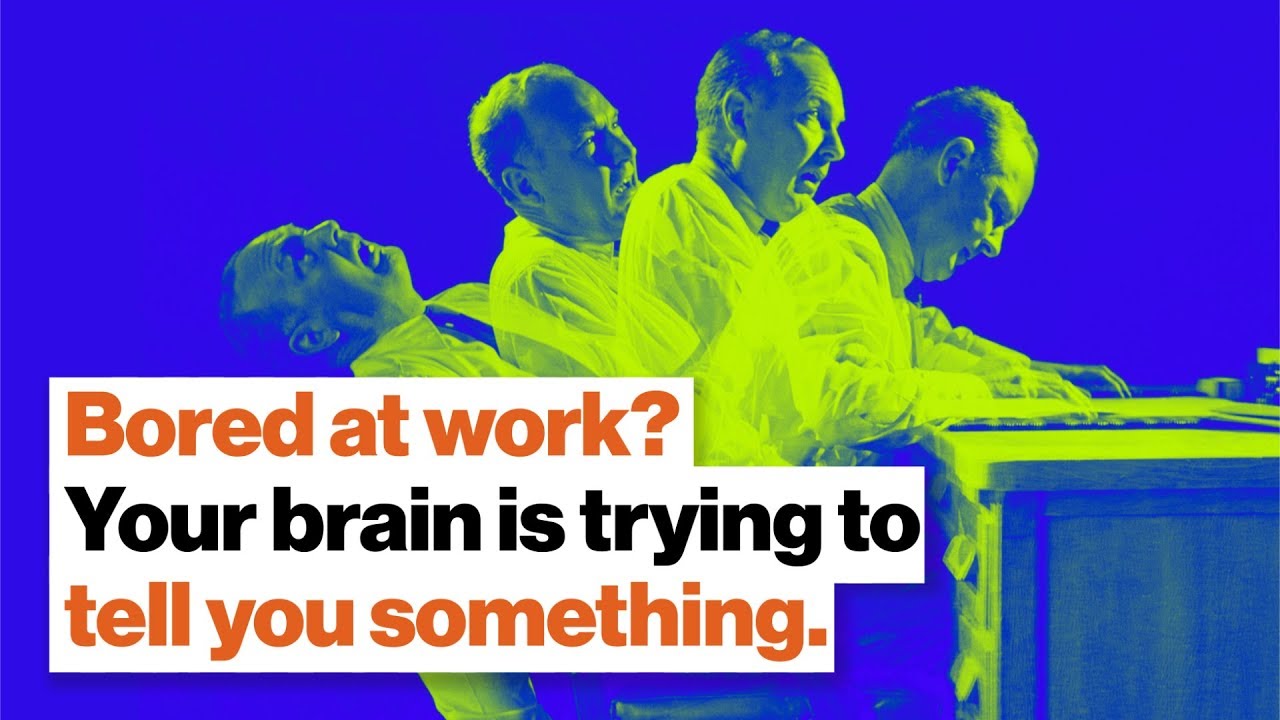
Bored out of your mind at work? Your brain is trying to tell you something.
New videos DAILY: https://bigth.ink
Join Big Think Edge for exclusive video lessons from top thinkers and doers: https://bigth.ink/Edge
———————————————————————————-
We’ve all been bored on the job at least once in our lives, but that boredom is actually very old human wiring. We constantly seek out new information to keep our minds sharp, and when tasks get repetitive we get bored and move on. But what if you can’t move on? What if the tasks are your job and you have to repeat them day after day to keep a roof over your head? That, says London Business School professor Dan Cable, is why boredom has become an epidemic. Our brains aren’t used to staying in their lanes, so perhaps that boredom is not a bug after all, but a feature.
———————————————————————————-
DAN CABLE:
Dan Cable is Professor of Organisational Behaviour at London Business School. Dan’s research and teaching focus on employee engagement, change, organizational culture, leadership mindset, and the linkage between brands and employee behaviors. Dan was selected for the 2018 Thinkers50 Radar List, The Academy of Management has twice honored Dan with Best Article awards, and The Academy of Management Perspectives ranked Dan in the ‘Top 25 most influential management scholars’.
———————————————————————————-
TRANSCRIPT:
DAN CABLE: Well about two years ago I stumbled on a piece of neuroscience that just stunned me. As a psychologist, I wish somebody had told me more about this but what I learned is that there appears to be a part of our brain called the ventral striatum, that’s the technical term, or you also could call it the seeking system. And this system is urging us to explore the boundaries of what we know. It’s urging us to be curious. And, by the way, I mean innately. I mean children six months old, three months old. If you give them some toy they love it for a little while. As they get used to it, your car keys become more interesting. It’s the new and it’s the desire to learn. And evolutionarily this system was developed to help us, to keep us learning. When I learned about this seeking system it really turned me on because it started to give me an insight into why disengagement from boring work, that may not be a bug. That might be a feature.
In the 2015-2016 Gallup polls, the evidence is that about 70 percent of people are not engaged in what they do all day long and about 18 percent of people are repulsed, they’re actively disengaged from what they do. And I think that the reason why I say this is a problem, and it could even be called an epidemic is because work is mostly what we do. We spend so much more time at work than with our families or with those things called hobbies. And so I think that the pervasiveness of people feeling like work is a thing that we have to shut off from, a thing that we can’t be our best selves, a thing that we have to get through on the way to the weekend. I think that is a sort of humanistic sickness and while it is bad for people, that’s the humanistic bit, it also is really bad for organizations who get lackluster performance.
I think that it’s interesting to think about when this all started happening and I didn’t live back in the 1850s, but all the records suggest that you could buy shoes and those shoes would be sold by some store, some cobbler. And maybe there would be three people that worked there. Rarely would there be five people that worked there. And while that probably wasn’t the best work in the world, each of the people in the store would watch the customer walk in and then they’d make a shoe for that customer. And they’d take leather and they’d sew it and then they’d give it. And around 1890 we got this different idea as a species where we should not sell two pairs of shoes each day, but two million. And this idea of scaling up had certain implications for how work felt. And part of that was because it was decided that the way to do this would have extreme efficiency by breaking the work into really small tasks where most of the people don’t meet the customer. Most of the people don’t invent the shoe. Most of the people don’t actually see the shoe made from beginning to end. And this idea of removing the meaning from the work was intentional. And the idea of removing the curiosity from the job was intentional. For Henry Ford curiosity was a bug, it was a problem and he needed to stamp it out in the name of reliability and quality. Now I’m not saying we’re still acting just like the 1900s, but I am saying that’s when we cut our teeth on management practices and the way we use control systems and punishments and extrinsic reward…
For the full transcript, check out https://bigthink.com/videos/top-10-why-am-i-bored-at-work


@bigthink
August 17, 2025 at 1:23 pm
Want to get Smarter, Faster?
Subscribe for DAILY videos: https://bigth.ink/GetSmarter
@stingbleu
August 17, 2025 at 1:23 pm
so it is intentional. everything, is intentional. and for what? profit? the very thing that makes us human is taken way from us that is curiosity. and then they make us do repetitive tasks form which we are absolutely replaceable and now mind you we have AI so our jobs hold even less value. how is everyone just okay with this? why is this so normalized? is this adulthood? how is no one replused?
@jasonscala5834
August 17, 2025 at 1:23 pm
Lack of competency building or even appreciation of competency in today's corporate world contributes a lot to dissatisfaction at work.
@a.nonymouse
August 17, 2025 at 1:23 pm
Let's be honest shall we? A generation or two ago our money was WORTH SOMETHING. Think about it, how much did your parents pay to buy their first home? How much did your grandparents pay to buy a home? What was the price of a house compared to what it is NOW? How much was their salary? 2 generations ago people actually had a much better QUALITY OF LIFE. A person could go to work, work a job, come home and provide for their family. Now it takes 2 people sometimes working multiple jobs to achieve FAR LESS THAN OUR PARENTS DID. Computers and "information technology" have created a plethora of WORTHLESS JOBS. Stuck behind a computer all day is the last place where a human being should be. It is the least constructive and worthwhile use of our time. People like Bill Gates, Mark Zuckerberg and even Elon Musk will be looked upon with scorn and derision by future generations for what they have done to humanity. The 21st century has been an absolute decline in human progress and I challenge YOU to prove otherwise. You've got questions. I've got answers. – A
@Sabossa
August 17, 2025 at 1:23 pm
Got bored at work clicked on this and got bored of it and going back to work now
@goldengriffon
August 17, 2025 at 1:23 pm
Loss of the Power Process, uncle Ted would say.
@Spacious_enough
August 17, 2025 at 1:23 pm
Couldn’t stand my massage job anymore.
Although I was good, just imagine doing it 5 times a day
Day in day out.
@franciswathika1202
August 17, 2025 at 1:23 pm
This helped me finally figure it out! Thanks man🙏
@ColdPotato
August 17, 2025 at 1:23 pm
Work has been boring for a while. The pay is good, but man…. Bursts of interesting stuff, then tons of checking this, that, figuring out what to do with myself.
@DonWonwz
August 17, 2025 at 1:23 pm
so many goddamn experts and not a single one of them know a darned thing for certain. all bs.
@zombieBAANAANAA
August 17, 2025 at 1:23 pm
Sad to see this is the reality for most. I’m 26 and I’ve managed to escape this by living frugally and saving 70% of my income so I only have to work half of the year every year and still have 40% left to put away for retirement. Life has been so much more enjoyable since I’ve started this. There is a way out!
@CaffieneAndSpite
August 17, 2025 at 1:23 pm
No shit sherlock
@fgl1985
August 17, 2025 at 1:23 pm
He just discovered Marxism … hahaha
@AdriLeverkuhn
August 17, 2025 at 1:23 pm
Misleading title, really dull video
@jihadyjeff
August 17, 2025 at 1:23 pm
This man is about to snap
@chaotic_anthologies
August 17, 2025 at 1:23 pm
We all gonna make it. Work needs to evolve. All of us will break out of the rat race.
@StevenWhite-o2u
August 17, 2025 at 1:23 pm
The brain pays too much attention to time passing.
@ericbeck6390
August 17, 2025 at 1:23 pm
AI?
@dotProcess
August 17, 2025 at 1:23 pm
I would willing get paid less in short term to do something I enjoy long term
@romerus6087
August 17, 2025 at 1:23 pm
This is a video you have to watch multiple times, because each time something different clicks.
Truly a gift that keeps on giving.
@Leapfrog44
August 17, 2025 at 1:23 pm
Yep. Gonna continue to be stuck at my miserable job at a large organization
Comments are closed.