
How Jupiter Protected Mankind on Earth
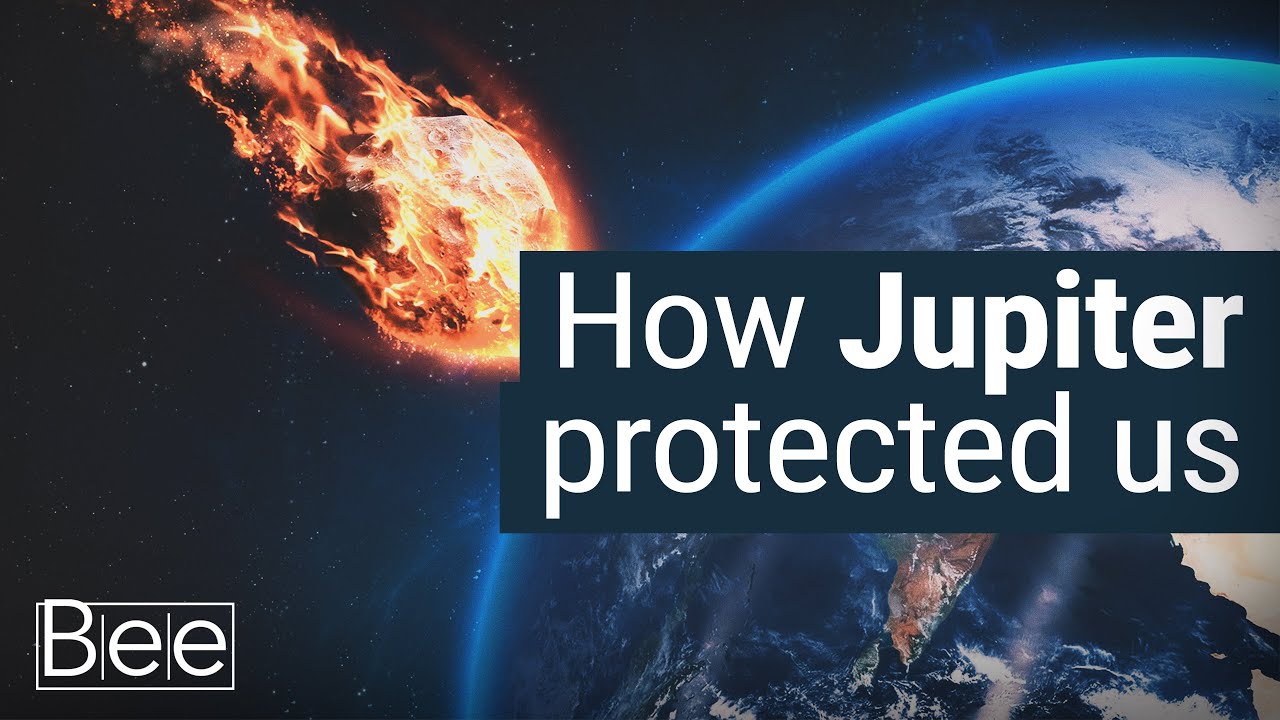
Some events in the cosmos may have helped or even hindered life on our planet. How did Jupiter protect the very existence of life here on Earth?
If you like to see more of these kinds of videos, support us by subscribing to this channel.
https://www.youtube.com/channel/UC65iOHIfKDesHEJDgzNHZsg?sub_confirmation=1
Follow us on Instagram: https://www.instagram.com/beeyond.ideas/
Cycles by Audionautix is licensed under a Creative Commons Attribution 4.0 licence. https://creativecommons.org/licenses/by/4.0/
Artist: http://audionautix.com/
——————————————————————————————————-
Script:
We think of outer space as distant and unreachable. An object hundreds of millions miles away might not affect us so much. But scientists know that in fact, there are events out in the cosmos that may have helped or hindered life on our planet. What if I told you, that a distant planet in our solar system is said to have protected mankind on Earth.
As you probably guessed from the title of this video, we’re talking about Jupiter. A giant planet 365 million miles away from Earth. But because of this distance, this planet is this small when viewed from Earth. How is this tiny dot even said to protect the very existence of life here?
#Jupiter has played a very important role in the history of mankind. The first finding of Jupiter dates back to at least the Babylonian astronomers between the seventh and eighth BC. In 1610, Galileo discovered Jupiter’s four large moons — Io, Europa, Ganymede and Callisto. With this discovery Galileo disproved the geocentric model of the universe, in which it was believed that the Earth was at the centre, and everything else revolves around it. Jupiter has helped revolutionise the way we see the universe, and ourselves.
As the most massive body in our solar system after the sun, the pull of Jupiter’s gravity has shaped the fate of our solar system. Some astronomers believe that one reason Earth is habitable is because the gravity of Jupiter does help us from external objects. But how?
In order to understand this, we need to go back a little bit. Most of us are familiar with the path-breaking discovery by Albert Einstein. “Gravity is the curvature of space-time caused by massive objects”.
In simple words we can say that heavy objects like the sun causes the space-time to bend. In much the same way as a trampoline would, when a heavy ball is dropped in it. This bending causes the planets around the sun to be caught in its gravitational field and revolve around it.
It’s the same reason why Jupiter is crucial for us. Its gravitational field is thought to sling most of these fast-moving ice balls, before they can get close to our planet.
Not only that, a new model known as the Grand Tack model, suggests that Jupiter might’ve flung material inward. Crashing hydrogen-rich asteroids and planetary embryos, into crowded young terrestrial planets. In doing so it might have gifted Earth with one of most important natural resources–water.
And a new research suggests that the delivery of this water, a key ingredient for life, may not have been luck. Instead, all planetary systems fortunate enough to host a gas giant in their outskirts should automatically have water-rich material falling on their rocky inner planets. Gaseous planets like Jupiter toss hydrogen-rich material that winds up locked into Earth’s crust and mantle, emerging later to bond with oxygen and become water.
Today, Jupiter not only does this but also prevents us from comets and meteors. Long-period comets, in particular, enter the solar system from its outer reaches. But with the help of Jupiter, it is thought to sling most of these fast-moving ice balls before they can even get close to Earth.
In simple words, we can say that the gravitational field of Jupiter, slings these long period #comets and throws them out of the solar system. Without Jupiter nearby, this external object would collide with our planet. We know about an asteroid that caused the extinction of dinosaurs, 65 millions years ago. Scientists believe this asteroid might have snuck past Jupiter and hit the earth. Its powerful gravity prevented space rocks orbiting near it from coalescing into a planet, and that’s why our solar system today has an asteroid belt. It consists of hundreds of thousands of small flying chunks of debris. Jupiter’s gravity continues to affect these comets and sometimes causes them to fly towards the sun where they initially had a possibility of colliding with the Earth. In 1770, a comet named Lexell, streaked pass Earth at a distance of only a million miles. It definitely sends #asteroids and comets our way.
So.. The real question that we wanna ask.. Is Jupiter really a protector of mankind? Well the answer is yes…and no. Apparently this gigantic planet is just following the physics of curved space-time.


@BeeyondIdeas
June 20, 2026 at 3:32 am
Is Jupiter really a protector of mankind? What do you think? Let us know in the comment section here!
@annaf.644
June 20, 2026 at 3:32 am
Jupiter is a Benevolent Planet 😇He Loves Mother Gaia💚🩵🤍thanks for this cool 🆒 video!!🎉🎉🎉
@nicholaspeter2796
June 20, 2026 at 3:32 am
Technically tye effects will be whene they ara all in line. Like ans eclipse. Otherwise jupiter will suck them all.pul from the other other side and pass them close to earth's gravitational influence
@realjupiteryeahohyeah
June 20, 2026 at 3:32 am
EZ L'BOZO ASTEROID
@AndreaLuiseC
June 20, 2026 at 3:32 am
… Am a Taurus m Lady
THE EARTH belongs To TauRus
@prasannap4219
June 20, 2026 at 3:32 am
In Hindu religion Jupiter is called Guru. Guru means Mentor.
@AbayonTravelTours
June 20, 2026 at 3:32 am
OK thank you Jupiter
@djdipak8693
June 20, 2026 at 3:32 am
Not Galileo it was way before him our Vedas and literature has established the fact as a result we celebrate the movement that is know as Maha Kumbh Mela, the largest human gathering on earth for a holy dip in river ganga. Pls put some more effort in learning.
@anjubhatia2652
June 20, 2026 at 3:32 am
Please refer to MahaKumbh in Bharat (aka India)….Great Hindu sages in ancient India had discovered this a long time ago…
@SpockvsMcCoy
June 20, 2026 at 3:32 am
The Aestroid Belt between Mars and Jupiter is not nearly as densely packed as your simulation. Objects within the Aestroid Belt of any significant size are usually 100,000 miles or even a greater distance apart.😮
@SharonBonds-j9p
June 20, 2026 at 3:32 am
All by the design of a Great and Mighty God , just like everything else in nature. The easiest way for a person to believe in God is to observe nature. Everything is by design, and for everything to be by design, Someone had to design it. These things don't "just happen".
@insansiregar6158
June 20, 2026 at 3:32 am
Short answer: Jupiter's huge gravitational field deflects comets and asteroids away from our delicate, rocky home planet.
@420bongking
June 20, 2026 at 3:32 am
mother earth, father jupiter
@DoubleDeckerDiarrhoeaDelight
June 20, 2026 at 3:32 am
Sorry to say this but, scientists have proved that a solar system without Jupiter would result in 3.5x less asteroid collisions here on earth. Search it up for yourself.
@borisandketo
June 20, 2026 at 3:32 am
Only GOD protects Mankind on Earth!
@jeffharrison1090
June 20, 2026 at 3:32 am
I'm always confused about this even after this video! Why wouldn't asteroids go towards the sun 10x the mass
of Jupiter? Also, with Jupiter's extremely long orbit of 12yrs, it seems that most of the time Jupiter isn't anywhere
near the Earth. Is it that since Jupiter is usually headed away from the Earth that asteroids "lock" onto Jupiter
and Jupiter either pulls asteroid's course away from Earth and more towards Jupiter. But then that goes back
to the primary question again…Why doesn't the asteroids just lock onto the Sun and fall into the Sun? Also,
is it possible that a video be made that demonstrates how Jupiter pulls, tugs, redirect asteroids? In this
video, it shows 5 seconds of visual clips but to untrained eyes it just look like a merry-go-round. thx!
@Jan_man11
June 20, 2026 at 3:32 am
So relaxing and nice I love your talking very slow this is so good thx so much
@aria.e
June 20, 2026 at 3:32 am
I'd like jupiter to stay around in sol for another hundreds of million years
@evanrutherfordlazyahole9079
June 20, 2026 at 3:32 am
Kinda crazy the safety nets that sustain life on earth.
@raynolimit
June 20, 2026 at 3:32 am
it was a rumor that Jupiter provides us with resources & also im just know studying as a astronomer at 18.
@simeonkwendo6302
June 20, 2026 at 3:32 am
Thanks Jupiter, for now!
@churchofpsychs1316
June 20, 2026 at 3:32 am
Church of psychs on TikTok
@churchofpsychs1316
June 20, 2026 at 3:32 am
I love your video. I am a spiritual leader that worships Jupiter as God. We should definitely chat about this.
@MrOptimusPrime.
June 20, 2026 at 3:32 am
The meaning of JUPITER is the chief Roman god, husband of Juno, and god of light, of the sky and weather, and of the state and its welfare and its laws.
@liveupsfinest6206
June 20, 2026 at 3:32 am
Jupiter: earth i like you
Earth: you… You do?
Jupiter: yes, now stay with me and I'll protect you ok?
Earth: ok
Mars: AHEM i help too
Saturn: yo this is about to get interesting
@trainer_boy
June 20, 2026 at 3:32 am
Jupiter SUS but i say hes safe