
The Science of Compassion: Kindness Is a Fundamental Human Trait | Big Think
The Science of Compassion: Kindness Is a Fundamental Human Trait
Watch the newest video from Big Think: https://bigth.ink/NewVideo
Join Big Think Edge for exclusive videos: https://bigth.ink/Edge
———————————————————————————-
Throughout his life, Thupten Jinpa (the Dalai Lama’s primary English translator) has studied the connections between science and compassion. In his latest book, A Fearless Heart, Jinpa builds off a landmark lecture given at Stanford Medical School to explain how we can take a scientific approach to train our compassion muscle to relieve stress, fight depression, improve our health, achieve our goals, and change our world.
———————————————————————————-
THUPTEN JINPA:
Thupten Jinpa Langri has been a principal English translator to the Dalai Lama since 1985. He has translated and edited more than ten books by the Dalai Lama including The World of Tibetan Buddhism (Wisdom Publications, 1993), A Good Heart: A Buddhist Perspective on the Teachings of Jesus (Wisdom Publications, 1996), and the New York Times bestseller Ethics for the New Millennium (Riverhead, 1999).
Thupten Jinpa Langri was born in Tibet in 1958. He received his early education and training as a monk at Zongkar Choede Monastery in Hunsur near Mysore, Karnataka, South India and later joined the Shartse College of Ganden monastic university, in Mundgod, Karnataka, South India, where he received the Geshe Lharam degree. He taught Buddhist epistemology, metaphysics, Middle Way philosophy and Buddhist psychology at Ganden for five years. Jinpa also holds a B.A. Honors degree in Western Philosophy and a Ph.D. degree in Religious Studies, both from Cambridge University, UK.
From 1996 to 1999, he was the Margaret Smith Research Fellow in Eastern Religion at Girton College, Cambridge and he has now established the Institute of Tibetan Classics where he is both president and editor-in-chief of the Institute’s translation series Classics in Tibet. He is also a member of the advisory board of the Mind and Life Institute, dedicated to fostering creative dialogue between the Buddhist tradition and Western science.
He is a Visiting Research Scholar at the Stanford Institute for Neuro-Innovation and Translational Neurosciences at Stanford University.
Geshe Thupten Jinpa has written many books and articles. His latest is A Fearless Heart: How the Courage to Be Compassionate Can Transform Our Lives.
———————————————————————————-
TRANSCRIPT:
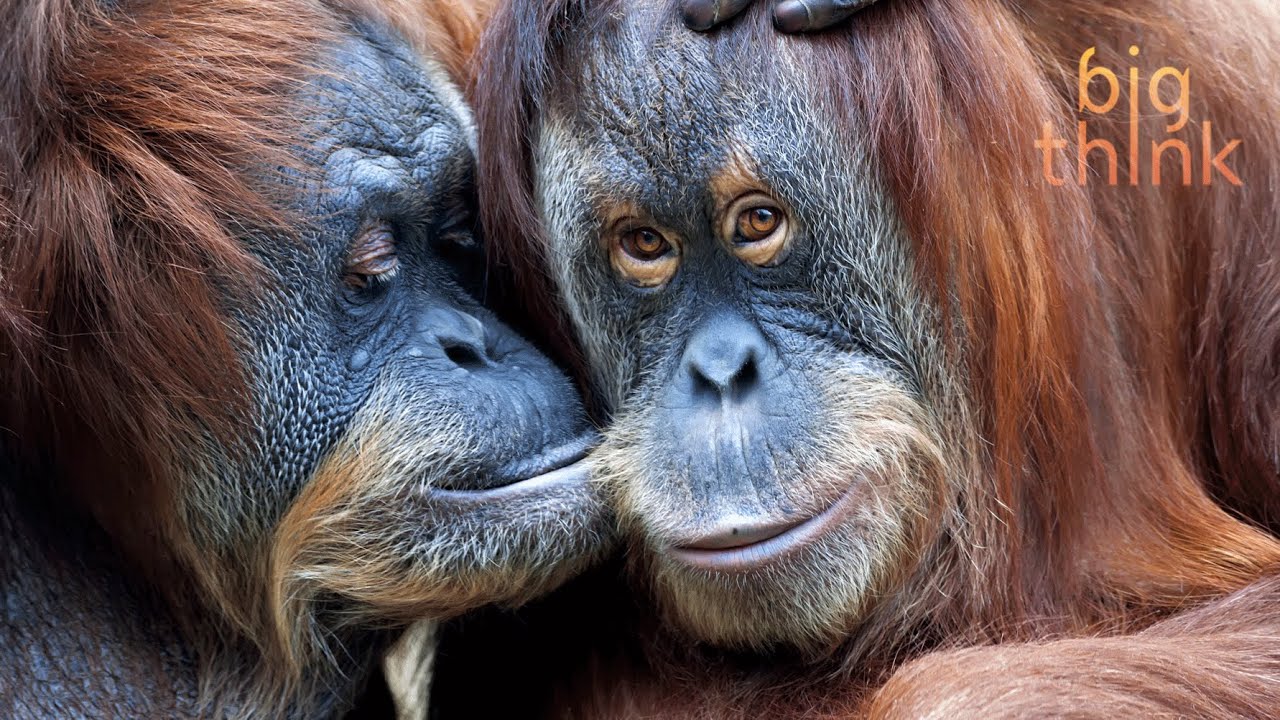
Thupten Jinpa: When we talk about the science of compassion, it’s also tied down with science of empathy. Empathy is compassion, altruism, kindness. They are all very interrelated and much of the current scientific studies really fall into two main categories. One is the study of altruistic behavior, particularly in animals and very young children. And the thinking is that if we can see altruistic behavior in animals and very, very young children, that it must have very deep biological roots. So that’s the kind of logic behind why they are focusing more on animal studies and children. The other important area that overlaps the science of compassion is the study of empathy. And again here, a lot of the work has been done on nonhuman primate studies and there is an American professor at Emory by the name of Frans de Waal and he was one of the pioneers. Many people might have seen the video of apes, you know; there were two juvenile apes fighting and one of them loses and another ape who’s not a blood relation comes over and hugs him and consoles him. So it clearly is an indication that empathy can be found in nonhuman primates as well.
And then there are some interesting studies coming from the studies of meditators who meditate many hours on compassion and then looking at their brain. You can actually see the brain’s expression in action. So this is called functioning in an MRI, which has the ability to look at a brain in action as it were. At least the claim is that the meditators are, unlike novices like us, have some ability to consciously direct their attention and thoughts so in the scanner, the brain-imaging scanner, you can ask the meditator: Can you do this? Can you do that? Can you just stay on the level of empathy and feel the pain? Now can you move onto compassion, wishing the other person to be free of suffering or wanting to do something about it. And try to tease out what brain signature, brain regions get activated when you are just in empathy feeling and when you are moving onto compassion when you are wishing to see the relief. In this way, the whole mapping of the brain regions that are involved in something like compassion is beginning to be done…..
To read the transcript, please go to https://bigthink.com/videos/science-of-compassion


@phdteacup
December 31, 2025 at 4:45 am
Obama?!
@charlestsebesta7812
December 31, 2025 at 4:45 am
Interesting
@alienkishorekumar
December 31, 2025 at 4:45 am
No human has compassion. It's all bullshit belief.
@martyr84
December 31, 2025 at 4:45 am
Sori Fierce Or it could have been that she was annoyed by the crying, or it reminded her of something in the past. Animals aren't as intelligent as you might think. Also personal anecdotes are not a good way to prove that animals have the same range of emotions as humans.
@umwha
December 31, 2025 at 4:45 am
Humans are no more kind than any other animal. Mother dogs will go hungry so their pups can eat. Birds will pluck out their feathers for their young. We humans are no diferent. We will sacrifice for the people in our own tribe. Just like animals.
@umwha
December 31, 2025 at 4:45 am
Childrne are not kind naturally. They have to be taught compassion. They also have to be taught how to say, tight rope walk. Therefore, tightrope walking is a fundamental human trait.
@thebatmanover9000
December 31, 2025 at 4:45 am
FREE HUGS FOR EVERYONE!
(>'.')>
@Bentehest
December 31, 2025 at 4:45 am
Actually, kindness is an element of harmony.
@sarukun1228
December 31, 2025 at 4:45 am
I don't understand why "scientists" haven't realized that animals have the same range of emotion as humans… I had my older cat for a year before I got the younger one… The older one started picking on the younger one, and threw a fit attacking me as well. So, I put her in timeout. (locked her in the cat carrier). After some time, she started crying cause she wanted out. As it went further, the younger cat (who mind you is afraid of the older one because of the aggression) walked over and started crying for me to let the older cat out as well. So even toward someone who seemingly hates her, my younger cat showed empathy to her crying.
@JRibs
December 31, 2025 at 4:45 am
The hard truth is that our compassion is actually a selfish trait, coming from the benefits of reciprocal altruism.
@CptBald
December 31, 2025 at 4:45 am
BEcause animal show so much Compassion in nature. The lion helping the Zebra…..
@kadind7741
December 31, 2025 at 4:45 am
Never knew Obama knew so much about animals. Glad he's our president
@FlabbyPigLegs
December 31, 2025 at 4:45 am
Fund
@marcoreus7146
December 31, 2025 at 4:45 am
First
@cbastor1
December 31, 2025 at 4:45 am
Humans are fundamentally compassionate? Tell that to the 150 billion animals slaughtered around the world every year.
@SHORAM8
December 31, 2025 at 4:45 am
What happened to all the scientists?
What's with this new trend of Author and religious figures? why not go to the source?
Comments are closed.