
Biosemiotics: A New Way To Understand Non-Human Consciousness | Dr. Yogi Hendlin
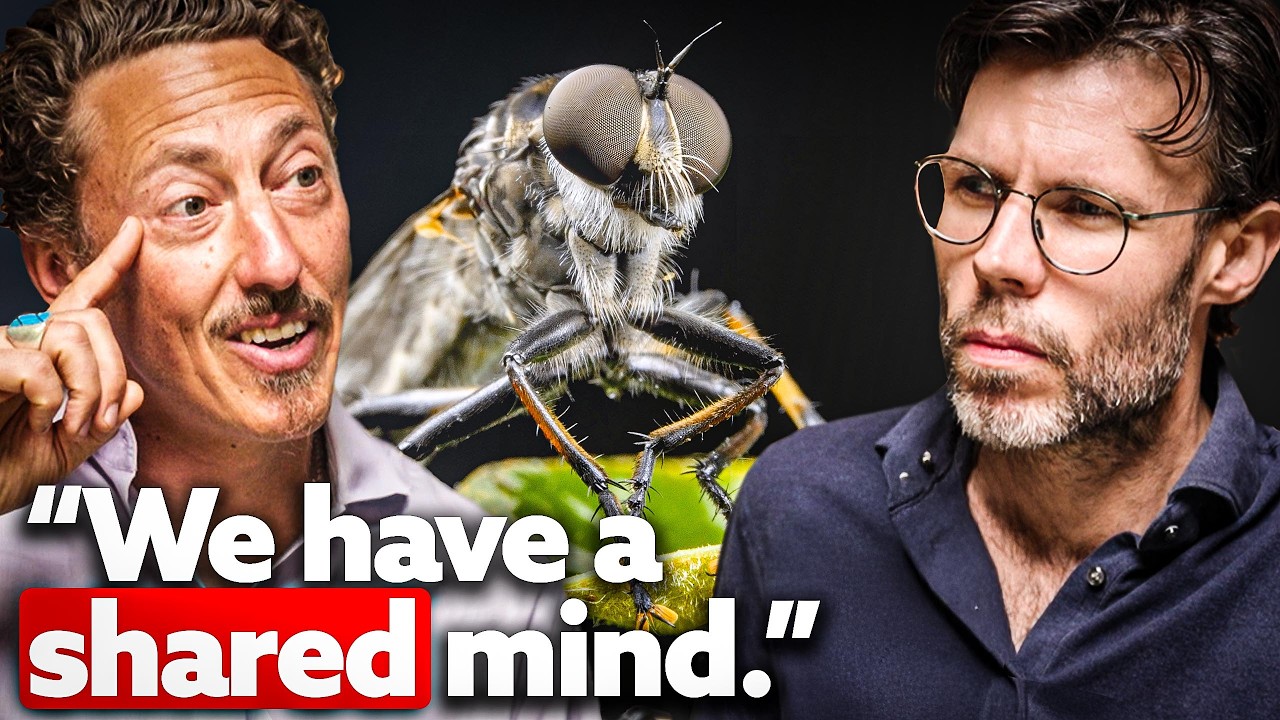
What if phenomenal consciousness, signs, communication, and interpretation are fundamental aspects of all living systems, whether or not we can detect brains? This is the departure point of biosemiotics, an interdisciplinary field that combines biology, semiotics (the study of signs and meaning), and philosophy.
Environmental philosopher Dr. Yogi Hendlin is Editor-in-Chief of the Journal of Biosemiotics and, in this conversation, Hans Busstra talks to him about the widespread meaning-making in nature. All living beings, from bacteria to plants to mammals, have an ‘Umwelt,’ a dashboard representation of the world. In a sense, biosemiotics states that our mind is in the world: we are embodied beings, and with every inhalation 50.000 microbes enter our body, and they communicate to us by influencing our microbiome.
0:00:00 Intro
0:03:20 Does nature speak to us in a language that we forgot?
0:08:18 The decentralization of agency
0:12:31 On the pluri-crisis
0:18:09 What’s the measurement problem in biology?
0:23:04 What is biosemiotics?
0:27:23 The overlapping of dashboards, of ‘Umwelts’
0:30:13 Semiocide: the killing of meaning
0:32:52 Reality as inhalation and exhalation
0:35:53 Psychedelics are Ecodelics
0:37:50 Hans on the love for a tree
0:43:29 ‘Shinrin-yoku’: forest bathing in Japan
0:47:55 Scrolling on our black mirrors: craving to be seen by the more-than-human world
0:48:55 On spiritual bypassing
0:54:30 The state of emergency we’re in
0:58:04 What is the crisis of reason behind the planetary problems we see?
1:07:25 We need to feel again
1:12:07 Hans and Yogi discuss the Mind at Large
1:14:58 How do we ‘report back’ to the universe?
1:18:19 If you have to suffer, make it beautiful
1:19:51 Yogi on his personal ‘dance’
1:24:25 Closing remarks
Links to Dr. Yogi Hendlin’s scientific work:
Khumalo, B., & Hendlin, Y. H. (2024). Nonveridical biosemiotics and the Interface Theory of Perception: Implications for perception-mediated selection. Phenomenology and the Cognitive Sciences. https://doi.org/10.1007/s11097-024-10013-y
Hendlin, Y. H. (2020). Sunlight as a Photosynthetic Information Technology: Becoming Plant in Tom Robbins’s Jitterbug Perfume. In K. E. Bishop, D. Higgins, & J. Määttä (Eds.), Plants in science fiction: Speculative vegetation (pp. 151–175). University of Wales Press.
Hendlin, Y. H. (2020). The human turn in biosemiotics. In Ľ. Lacková, C. J. Rodríguez, & K. Kull (Eds.), Gatherings in Biosemiotics XX. University of Tartu Press.
Hendlin, Y. H. (2023). Object‐Oriented Ontology and the Other of We in Anthropocentric Posthumanism. Zygon. https://doi.org/10.1111/zygo.12864
Hendlin, Y. H. (2021). Surveying the Chemical Anthropocene: Chemical Imaginaries and the Politics of Defining Toxicity. Environment and Society, 12(1), 181–202. https://doi.org/10.3167/ares.2021.120111
Other scientific work referenced in the interview:
Asher Walden’s essay
https://www.essentiafoundation.org/the-symbiotic-ecology-of-the-psychedelic-realm/reading/
Primates Meditating
Smuts, B. (2001). Encounters with animal minds. Journal of Consciousness Studies, 8(5–6), 293–309. http://www.ingentaconnect.com/content/imp/jcs/2001/00000008/F0030005/1213
On Human-Dolphin fishing
Zappes, C. A., Andriolo, A., Simões-Lopes, P. C., & Di Beneditto, A. P. M. (2011). ‘Human-dolphin (Tursiops truncatus Montagu, 1821) cooperative fishery’ and its influence on cast net fishing activities in Barra de Imbé/Tramandaí, Southern Brazil. Ocean & Coastal Management, 54(5), 427–432. https://doi.org/10.1016/j.ocecoaman.2011.02.003
On ‘tree-hugging’ in India
Shiva, V., & Bandyopadhyay, J. (1986). The Evolution, Structure, and Impact of the Chipko Movement. Mountain Research and Development, 6(2), 133–142. https://doi.org/10.2307/3673267
On Elephants helping people survive after the Sri Lankan Tsunami
Wikramanayake, E., Fernando, P., & Leimgruber, P. (2006). Behavioral Response of Satellite-collared Elephants to the Tsunami in Southern Sri Lanka1. Biotropica, 38(6), 775–777. https://doi.org/10.1111/j.1744-7429.2006.00199.x
Tsunami images under fair use policy
All stock footage licensed under Storyblocks
Music licensed under Soundstripe
Interview content copyright by Essentia Foundation, 2025
www.essentiafoundation.org


@anajardimbr
August 15, 2025 at 3:07 am
This is another phylosophical approach to reality as well as any other way it is done by other observers of our world and universe. Nothing too special.
@GianfrancoCavallaro
August 15, 2025 at 3:07 am
Hello and thank you for the insights you provide in your videos. It seems that elephants perceive infrasound, very low frequencies that we can't hear, through the contact of their feet on the ground; perhaps they sensed with this ability frequencies that accompany and precede the tsunami…!
@Bouper66
August 15, 2025 at 3:07 am
Beautiful- thank you
@austindecaux7895
August 15, 2025 at 3:07 am
Is 5EA truly the first strand type philosophy? 🤔
@sassduffin4274
August 15, 2025 at 3:07 am
I was driving home in my ute/pick-up this afternoon. A crow was drinking from a puddle on the side of the road. I stopped a way back so he could finish his drink undesturbed. When he or she had finished l drove on. The best bit was that the road was silent, just me in my vehicle, when usually it is a busy road: the universe or God agreed that this crow have his drink ❤
I am a shepherd, retired truck driver and a woman that spends her every day with her horses.
This interview video is vutally important, incredibly joyful, truthful. Thank you to you both 🙏🥰❤
@Aquaussie
August 15, 2025 at 3:07 am
Listening to this conversation was like going on a journey through a dark forest, and each idea as it was elucidated transformed the shadows into a golden light, the experience was just so delightful and expansive and generous. I felt privileged to hear and see the wonder of refined human intelligence flexing its strength like an Olympic athlete. There were many profound ideas, but I am in Australia near the Sunshine Coast in Queensland and I am reminded of the Aboriginal people, of the Gubi Gubi and Jinibara people, who had a tradition dating thousands of years of a father passing custodianship to the first born son to care for a specific tree, the Bunya Bunya tree that can live for 600 to 1,000 years. The trees produced a protein rich seed and many tribes would gather for cultural events at this time of year. When Europeans arrived they saw the trees as commodities to be logged, in the 1860’s these ancient Bunya Bunya trees were cut down en masse. The intergenerational connection with the indigenous people and the trees was severed, a shameful history of violence and theft that has not yet been adequately understood nor addressed on this land, and this is not my story to tell, and I have only given a crude outline of it, but it speaks of the love we naturally feel for nature and how we lose this deep connection when we view the natural world as a commodity as a non-being for instrumental use in economic markets for ‘progress’. It gives me hope to see and hear ‘western’ intellectual ideas move towards a more sophisticated awareness, one that was held for thousands of years by the original inhabitants of this land.
@whatelse2962
August 15, 2025 at 3:07 am
I love watching nature documentaries. Even as a kid I loved to watch them.
And I always watch them when I feel lost or sad. It makes me feel connected to something bigger than me. And safe.
Nature never stops amazing me.
We are all connected.
@marijaparlov2101
August 15, 2025 at 3:07 am
❤thank you for posting this
@alanafraser8136
August 15, 2025 at 3:07 am
This is such a beautiful conversation and much needed🙏🏽 thank you so much
@zoejackson5890
August 15, 2025 at 3:07 am
53:41 Yes we need to stop thinking we are powerless and that our voices are incapable of change and power.
@Clyne-sv4hd
August 15, 2025 at 3:07 am
Great interview 👍
@elizabethhardy5357
August 15, 2025 at 3:07 am
I started crying during the opening ❤😅 nature is the only thing that actually makes me want to be alive in this weird messed up world
@ms.q7445
August 15, 2025 at 3:07 am
What we call rational is based on the assimption we can destroy everything and prosper—and that is psychosis.
@thecentreofinfinity5865
August 15, 2025 at 3:07 am
I intuited that shingles virus tells my brain to eat what it needs…
@Purplekeys05
August 15, 2025 at 3:07 am
I am a synesthete and it is a flavor genius.
I experience it more when I am in love.
@rozaucja8612
August 15, 2025 at 3:07 am
All those beautiful methaphors about hitting the bulls eye… We're watching our language aren't we. The language of animal Holocaust
@rozaucja8612
August 15, 2025 at 3:07 am
All of that beauty and wisdom and then he mentions chickens, whose eggs he steals..
@louiseann_venusandneptune
August 15, 2025 at 3:07 am
A very wonderful interview. Great openness from both sides. Lovely to hear this level of breadth, width, and depth of awareness. 🙏🏻 😊
@louiseann_venusandneptune
August 15, 2025 at 3:07 am
26:30 I call that over lap (if I’m understanding this discussion) as my collaborative, (if its helpful to both parties), conscious (if we are aware of it) vibrationship – because the information has to be read in vibration code first and then translated by our own specific equipment to our own specific language, understanding.
@fish.e
August 15, 2025 at 3:07 am
We are Earth.
@katdm6472
August 15, 2025 at 3:07 am
Pleaaaasseee can you have a neuronal entrainment researcher onto the podcast!!!
Comments are closed.