
If these pumps ever stop, part of Germany floods.
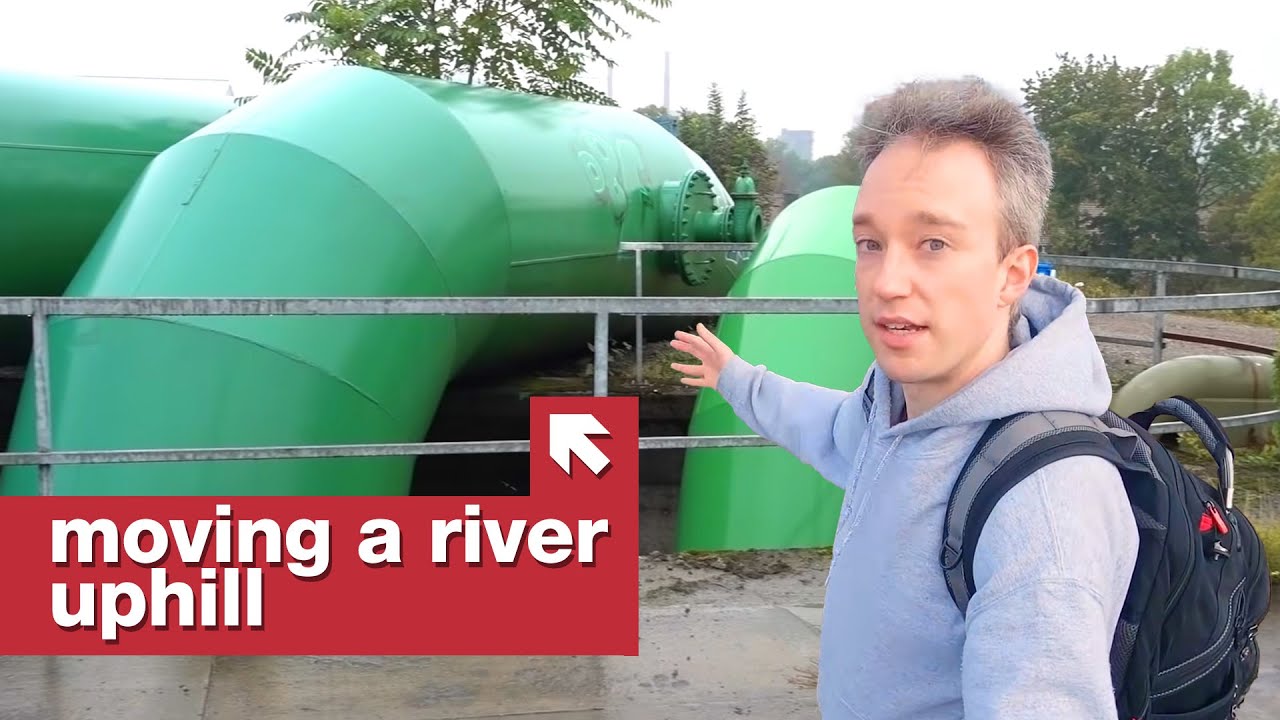
The Ruhr Valley, in north-west Germany, is an industrial coal-mining area. And because of that kilometre-deep mining, parts of it have sunk, the drainage patterns have changed: and now, if the pumps of Emschergenossenschaft ever stop, quite a few towns and cities will end up flooded.
Filmed safely in September 2020: https://www.tomscott.com/safe/
REFERENCES:
https://www.derwesten.de/region/rhein-und-ruhr/wenn-die-pumpen-stillstaenden-id12358775.html
https://fxreflects.blogspot.com/2008/12/ruhr-valley-secrets-richard-serras.html
— and of course, my interview with the team from Emschergenossenschaft
Edited by Michelle Martin https://www.youtube.com/@OnTheCrux
Thanks to Bela Lempp and Daniel Fischer for the suggestion.
(Alternate title: “Iffen Pumperschtoppen, Der Deutschehabitaten Unterwasser”. Alternate video: https://www.youtube.com/watch?v=6LvY6vQQET8 )
🟥 MORE FROM TOM: https://www.tomscott.com/
(you can find contact details and social links there too)
📰 WEEKLY NEWSLETTER with good stuff from the rest of the internet: https://www.tomscott.com/newsletter/
❓ LATERAL, free weekly podcast: https://lateralcast.com/ https://youtube.com/lateralcast/
➕ TOM SCOTT PLUS: https://youtube.com/tomscottplus
👥 THE TECHNICAL DIFFICULTIES: https://youtube.com/techdif


@TomScottGo
August 5, 2025 at 5:48 pm
This was, of course, filmed back when some inter-European travel was possible, following all the Covid-safe guidelines. (Standing on top of a windswept hill helps with that.)
@JayRioLasRocas
August 5, 2025 at 5:48 pm
i live there and i love it 💙🤍
@PrincessOfSpace42
August 5, 2025 at 5:48 pm
You've been to Bottrop and I have missed it??? what a sad world we live in
@InfiltrateIndustries
August 5, 2025 at 5:48 pm
Tom’s a linguist – but pronounced it “ki-lom-eter”.
No no bad. Kilo-meter please
@Protoscherge
August 5, 2025 at 5:48 pm
miss you!
@mylittledashie7419
August 5, 2025 at 5:48 pm
0:41 if this wasn't at least partially inspired by Pathologic, I'll be very surprised. It'd fit right into the game.
@pukas7389
August 5, 2025 at 5:48 pm
Anyone here in 2025
@aaron_787
August 5, 2025 at 5:48 pm
Der deutsche Akzent 😂😂 ich Liebs 😂
@MajinObama
August 5, 2025 at 5:48 pm
I love the American Culture-hate in the comments 😄 Music to my ears…
@Mixtapes3
August 5, 2025 at 5:48 pm
Nice, thank you – didn't know this specific fact about my own region.. 🙂
@AndreasDenkste
August 5, 2025 at 5:48 pm
"Art". And the problem is actually way more complex since the area was prior to coal being mined an ACTUAL SWAMP. some 200-100 years earlier than mining, the swamps were drained by diggin canals to make room for agricultural land to provide for the ever growing cities in the region there.
Turns out it's massively stupid to mine at a scale like this in a former swamp and not expect increased flooding afterwards.
@1s3ngr1m
August 5, 2025 at 5:48 pm
Not the "Ruhr Valley", but the "Ruhrpott"…so more fitting would be a "Ruhr cauldron"…especially as most of the Ruhrpott is well above sea level, thus not a valley.
But kudos for visiting my neighboring "Zeche Haniel" hill…or "Schlackeberg" as we call him.
@Sewer.R4tz
August 5, 2025 at 5:48 pm
I actually visited the coal mining museum a few years ago
@imageflairfx
August 5, 2025 at 5:48 pm
wo sind meine jungs aus bottrop
@blizz606
August 5, 2025 at 5:48 pm
I live near there in Bergkamen
@schusterlehrling
August 5, 2025 at 5:48 pm
Actually even before the coal and mining places there were a lot if swamps around the region. Names that end in -bruch inducate that thete had been a swamp for instance.
@Morboxx
August 5, 2025 at 5:48 pm
To me, this highlights something that is going to happen with nuclear power and that people don't really forget because it's inconvenient. There will be eternal costs and taking care of nuclear waste. There's no way around it. And finite gain is always outweighed by eternal cost, seriously. So nuclear can always only be a stepping stone, nothing more.
@B.Ies_T.Nduhey
August 5, 2025 at 5:48 pm
In Chicago, they did something like that to make the river flow toward St. Louis/ Missisippi, not Lake Michigan, for the waste.
Didn't understand how that works though…
@B.Ies_T.Nduhey
August 5, 2025 at 5:48 pm
😱 Of all the things I didn't know…
I dare not watch your channel, it teaches me too much.
@GI_D204
August 5, 2025 at 5:48 pm
Bad weather in Germany, the classic, I think that is a thing England and Germany have in common, the tendency for bad weather. 😂
@larspolten
August 5, 2025 at 5:48 pm
Ja, hunderttausende Euro pro Jahr auf hunderte Jahre. Die Folgen der Industrialisierung.
@Kiiltec
August 5, 2025 at 5:48 pm
The kind of shortsighted direct profit focussed thinking that has already created plenty of issues.
@TheNormMan
August 5, 2025 at 5:48 pm
40.000 liters.. per SECOND..!! what the hell
@hiha2108
August 5, 2025 at 5:48 pm
Zur Info für die Kernkraftfreunde: Auch der stillgelegte Uranbergbau unterliegt dem ständigen Abpumpen und Entseuchen von Grubenwasser.
@winni2701
August 5, 2025 at 5:48 pm
This video explains Germany better than anything else:
A pump must be powered all the time because of mining of some ending amount of coal….
@moritz7179
August 5, 2025 at 5:48 pm
Another aspect showing the insanity of fossil fuels. And no the mining corporations don't pay for that, in the end it's always taxpayer money. Capitalism is always about privatizating profits and socialising losses, also in Germany.
@buntbar2438
August 5, 2025 at 5:48 pm
Who would have guessed…
… many people think nuclear waste isn't a problem .
@euckb
August 5, 2025 at 5:48 pm
Some of that art, the amphitheatre and the landscape looks like Eastern Germany if you know what I mean.
@Leberteich
August 5, 2025 at 5:48 pm
Das genaue Gegenteil von einem Wasserkraftwerk.
The exact opposite of a hydroelectric power plant.
@hoodio
August 5, 2025 at 5:48 pm
the river must flow
tom scott 2020
@Hardcorius
August 5, 2025 at 5:48 pm
Having lived at both ends of the Ruhr Valley for some years, it's kind of funny how much I got used to all of this. Those heaps (or Halde, as we say call them in German) are scattered throughout large parts of both the Ruhr Valley and also the Rhineland (e.g. where the Garzweiler surface mine is located). While it's our usual landscape, we often forget about the scale of those hills and the problems all of this mining caused. It's not just the risk of towns getting flooded, there is also a realistic chance in some areas for infrastructure to just sink or collapse due to unstable ground. Just a few months ago we had a sinkhole right under one of the biggest highway intersections, resulting in completely chaotic traffic in that area for some days. Sure, "companies have to pay", but in reality, they just pay for the bare minimum to "hide" the problems, which is why infrastructure in this area (highways, bridges, some residential areas) has been falling apart for some years now and needs constant repairs.
@BloodyMobile
August 5, 2025 at 5:48 pm
40k liters a second, so roughly 40 tons of water per second… I have problems visualizing how much that is…
The closest I'm getting is those pumps shoving a small tank upstream. One per SECOND…
@bertrackmunisz1684
August 5, 2025 at 5:48 pm
For your information, it is not only the Ruhr area where the pumps have to run 24/7, the same applies to parts of the left Lower Rhine. Without the constant pumping, our city and the surrounding area would become a huge lake within 6 weeks. The entire affected area to the left of the Rhine is 620 square kilometers in size.
@janneskraus3446
August 5, 2025 at 5:48 pm
1:00 thats scholven a it is in my region near it is also the Movie park Germany
@HelloKittyFanMan
August 5, 2025 at 5:48 pm
So what happens when the last coal company in that general area goes out of business, or now that they already have? And if this is an indefinite cost of electricity and maintenance but moving the dirt back is finite, and even though it took them decades to move that much, it was slowly done, right, so why not doing it more quickly now, in construction mode, and then that cost finally goes away rather than continuing to pump indefinitely?
@SanderMakes
August 5, 2025 at 5:48 pm
The Ruhr Swamp? You mean the Netherlands?
@CEmpty2044
August 5, 2025 at 5:48 pm
Reflecting in view that germany may experience a multi day nationwide power outtage they may just go out.
@flavoredchin
August 5, 2025 at 5:48 pm
comparing this to the Yellowknife mine video makes me sad.
@SgtTibbs31
August 5, 2025 at 5:48 pm
Apres moi le deluge
@Whitehalo732
August 5, 2025 at 5:48 pm
Why don’t the Coal mining companies move the mined dirt back underground?
@garryferrington811
August 5, 2025 at 5:48 pm
Anthracite is hard coal, and was particularly difficult and dangerous to mine underground. It was used to fire several railroads in the northeastern US and burned "clean," without cinders and soot.
@mailam8846
August 5, 2025 at 5:48 pm
As a German who lives in Hamm, a fairly industrial city, I can indeed say that the impact that coal mines have had on some German towns is baffling. I see crumbling buildings and unnatural landfills all around, and I'm glad we are putting an end to it.
@salamander405
August 5, 2025 at 5:48 pm
0:40 He doesn’t know about Pathologic….
Comments are closed.