
Wiyapka Lake Pack travels through snowy woods in fall
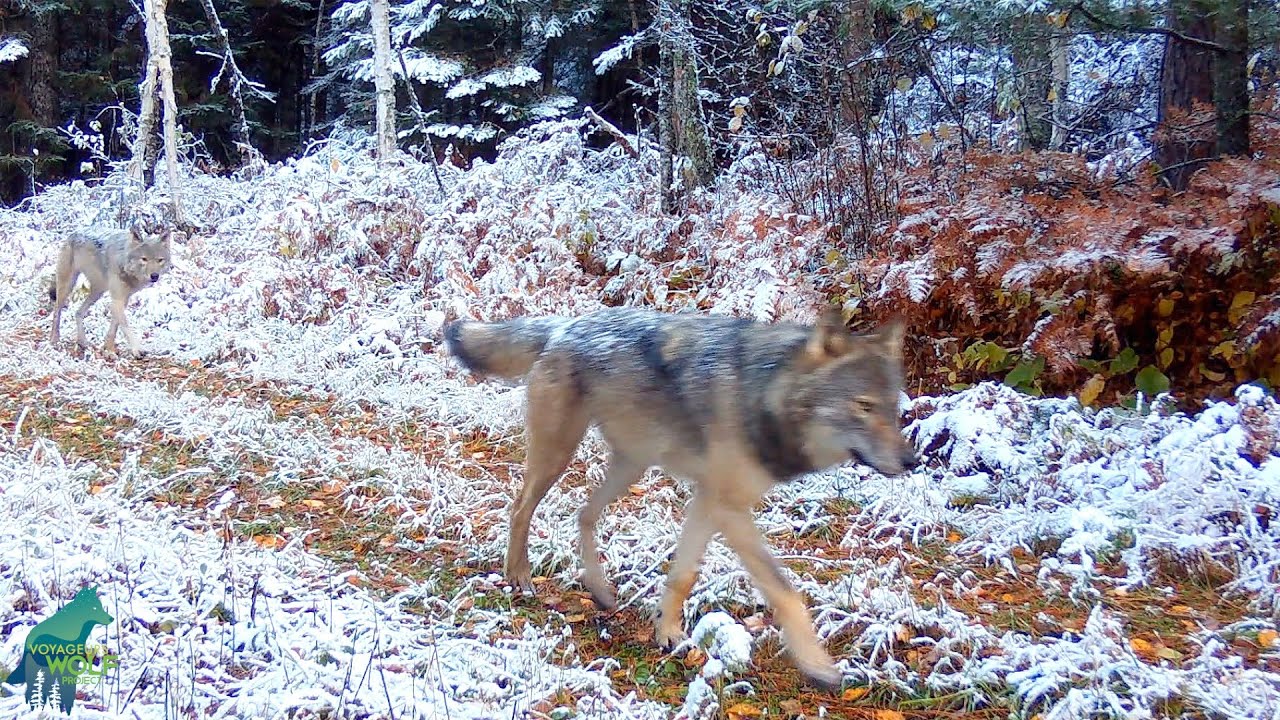
Out with the old pups and in the new: this sums up the annual cycle of the typical wolf pack in our area…and the saga of Wiyapka Lake Pack over the past year is a perfect example of this!
In early 2021, the Wiyapka Lake Pack was 2 wolves: the breeding pair. In Spring 2021, the pack had 6 pups, three of which survived to adulthood. Thus, the pack was 5 wolves strong in last winter (the breeding pair plus 3 pups).
This spring, the pack had another 6 pups and all 3 pups from 2021, who were now yearlings, were still around. Thus, the pack was 11 wolves now. We collared 2 of these yearling wolves (Wolves R1T and R2L) in May of this year.
By August, three of the new pups were still alive and all 3 yearlings were around as well. But the death of three pups meant the pack was now down to 8 wolves (breeding pair, 3 yearlings, and 3 pups).
In late summer/early fall, R1T and R2L dispersed from the pack in search of greener pastures (their own territory and/or a mate). R1T is currently a few miles west of Ely, Minnesota and R2L is in northern Wisconsin currently. Around this same time, the number of surviving pups went from 3 to 2.
The pack was now down to 5 wolves—the breeding pair, a yearling, and two pups…the same size it was the previous winter.
Notably, by late fall, the yearling was only hanging out with the pack intermittently, possibly indicating it will disperse but who knows! In the video above, we see the breeding pair of the Wiyapka Lake Pack with two pups in October but without this yearling.
If the yearling leaves but both pups survive, then the pack will be 4 wolves this winter. If the yearling stays and both pups survive, the pack will be 5 wolves. Average pack size over the past decade was 4.6 wolves per pack and the Wiyapka Lake Pack will likely be very close to, or maybe even above, that average this winter.
Regardless, this illustrates the annual cycle of wolf pack dynamics in our area: new pups are born, some pups do not survive, and once pups get older, they disperse from their pack.
Importantly, changes in pup survival and dispersal are also some of the ways that wolves naturally regulate their own populations—i.e., how wolf populations can change their size in response to changes in food availability.
Learn more about the Voyageurs Wolf Project:
Website: http://www.voyageurswolfproject.org
Facebook: http://www.facebook.com/VoyageursWolfProject
Instagram: http://www.instagram.com/voyageurswolfproject/
Twitter: http://www.twitter.com/VoyaWolfProject
TikTok: http://www.tiktok.com/@voyageurswolfproject


Comments are closed.