
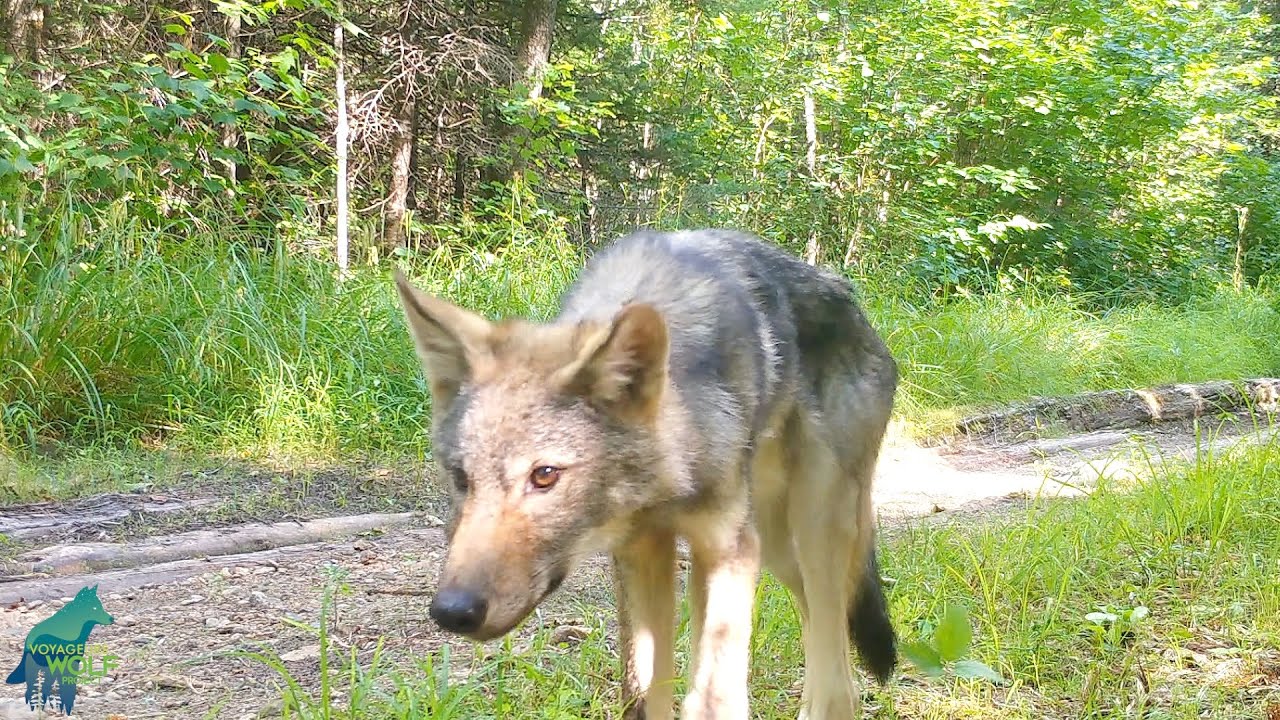
Lean wolf pups in late summer in northern Minnesota
Summers, starvation, and survival: wolf pups. A few weeks back, we discussed the long periods of time that adult wolves can go with minimal food during late summer and early fall— the leanest time of the year for wolves. But what about wolf pups during this time?
Wolf pups are still largely dependent on the adults for food in late summer and early fall. However, not only are pups dependent on the adults, but they need more and more food as they continue to grow and get bigger.
Thus, late summer puts adult wolves in a bind: they need to find more food and more food to feed their growing pups and yet prey is much harder for them to catch and kill. In other words, the well is drying up at the time when they really need it to be full.
So what happens? Well, adult wolves in our area almost always survive this lean time, albeit they can look very thin and lean. Pups are a different story. This late summer and early fall period often corresponds to a period of increased pup mortality due to starvation.
As such, it is not uncommon for us to see some pups in late summer looking lean and ragged, or to see pups that look much smaller than they should for the time of year (indicating they are malnourished and their odds of survival not so great).
The video above are of Wiyapka Lake pups in 2020. 5 of the 6 Wiyapka Lake pups survived until August. But by August, as you can see in the video, most of the pups looked very thin, haggard, and some looked pretty small. By late fall, none of the pups were alive. We cannot say for certain that they all died of of starvation but we think it seems likely.
Notably, when pups starve to death, it is not because there is no prey around but rather the prey are not as available or vulnerable and thus, cannot be killed as readily. So functionally, the amount of food available and accessible to adult wolves is much lower than it is the rest of the year.
Worth noting: we are speaking in general, overarching patterns about pup survival, food availability, and starvation. We have documented many instances where packs have overcome this period of reduced availability and successfully reared all of their pups to adulthood. But there are also many packs, like the Wiyapka Lake Pack in the video, that have had precipitous declines in pup survival during this period as well.
Nonetheless, wolf pup survival is one of the natural mechanisms that regulate wolf population size and that allows wolf populations to fluctuate in size with prey availability. This is why the idea that wolves can continue to persist at high levels while decimating prey populations is nonsense. Rather, populations adjust to the amount of prey, and one populations adjust is through changes in pup survival.
Indeed, fluctuations in pup survival are likely what has allowed the wolf population in our area to remain stable and at a high-density for several decades. As such, this is why we have such a keen interest in trying to understand wolf pup survival rates in our area and more importantly what drives the variation in pup survival rates that we see.
As Fuller et al. (2003) stated in their review of wolf population dynamics: “…it is easy to see that annual change in pack or population size is most dependent on the fate of wolf pups”.
Learn more about the Voyageurs Wolf Project:
Website: http://www.voyageurswolfproject.org
Facebook: http://www.facebook.com/VoyageursWolfProject
Instagram: http://www.instagram.com/voyageurswolfproject/
Twitter: http://www.twitter.com/VoyaWolfProject
TikTok: http://www.tiktok.com/@voyageurswolfproject


Comments are closed.