
Tribute to Alan Lamb by Lawrence English
The Whispering Wires: Alan Lamb’s Sonic Journey Through Time and Nature
In the realm of sound art, where the lines between art and science blur, few pioneers have charted such an adventurous course as Alan Lamb. The Australian sound artist’s journey into exploratory audio is a testament to how chance encounters can shape a lifetime of creativity and inquiry.
From the lush landscapes of Perthshire, where he first pressed his ear to telegraph poles under the guidance of his nanny, My, Lamb discovered early on that nature hides a symphony within its silence. The simple act of listening, encouraged by his childhood companion, set him on a path of deep exploration that would intertwine with his later academic pursuits in biomedical research.
After emigrating to Australia in 1951, Lamb’s formative years were spent in Peppermint Grove, a suburb that blossomed near the Swan River. Although initially captivated by academia, studying medicine and physiology, it was the allure of sound that ultimately beckoned him back to the arts. His epiphany came in 1971, inspired by an exhibition of kinetic art at London’s ICA, leading him to visualize sound-scapes in ways few had dared to imagine.
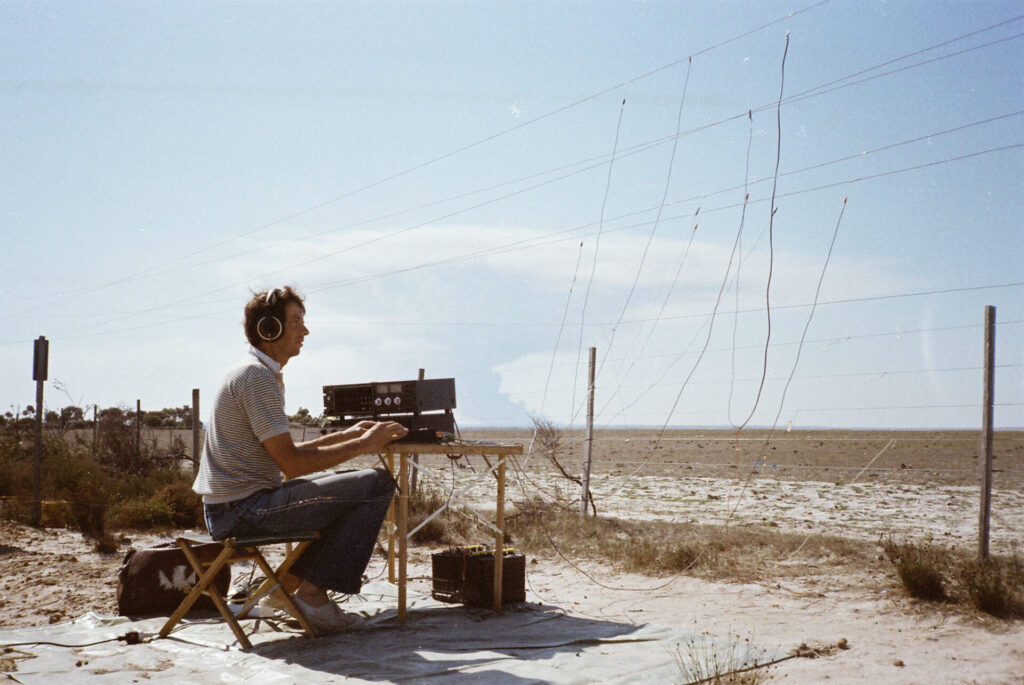
His exploration took a crucial turn during a fateful holiday on the Isle of Mull. There, as a gentle wind sang through overhead telephone lines, he was captivated. This moment of pure serendipity echoed his childhood experiences and sparked an obsession with capturing this ethereal presence in his work. A follow-up visit to a farm near Fitzgerald National Park revealed an array of abandoned telegraph poles, and for just $10 AUD—modern-day $76—these soon became his auditory canvas, dubbed the Faraway Wind Organ.
Lamb’s works laid the foundation for what would become a new vernacular of sound in Australia. For nearly a decade, he recorded these haunting vibrations, birthing compositions such as Night Passage, Primal Image, and Beauty. Yet, while his live performances at venues like Fremantle Art Gallery and national broadcasts on the Australian Broadcasting Corporation’s Surface Tension captured audiences, they remained largely underground treasures until rediscovered by the masses in the 1990s through Darrin Verghagen’s imprint, Dorobo.
What’s truly startling about Lamb’s catalog is its timelessness; the recordings encapsulate a dialogue with the natural world that feels both of this moment and extraordinarily ahead of its time. Listening to Lamb’s pieces today, one can’t help but feel a sense of the eerie, a ghostly echo of Mark Fisher’s uncanny, as wires stretch and recoil, narrating a story that transcends simple sound.
In his meticulous craft, Lamb has developed an innovative methodology that grasps not just the sound, but the fabric of the environment—the hum of the wind, the perturbations of insects, even the flight of birds—transforming these interactions into a vibrant tapestry of audio. One can even detect the intricate sonority of a crow gliding through the wires, its call reverberating with a poignant resonance that defies categorization.
Alan Lamb is undeniably a beacon for a generation of sound artists and makers, a guide through the chaotic harmonies of our existence. His work invites an intriguing contemplation of how even the smallest, most innocuous moments can cascade into a lifetime of exploration and delight.
As we revisit masterpieces like Primal Image, we’re reminded that Lamb’s sonic legacy is not just about sound, but about fostering an insatiable curiosity for the world around us—a gentle nudge toward listening, appreciating, and reveling in the ever-present murmurings of life itself.
In a world filled with noise, thank you, Alan, for teaching us how to truly listen.


